“Surry Hills must be the only place outside the former Soviet Union where people queue for bread.”
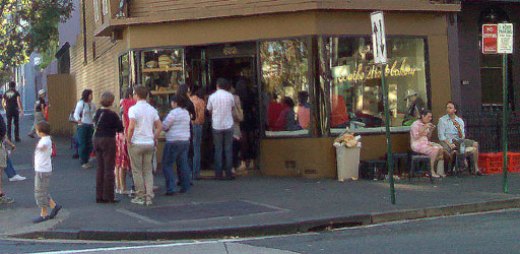
Bourke Street Bakery in 2007
In the time since, the very popular Bourke Street Bakery has expanded, with a number of other venues across Sydney.
Though it’s only a short walk from where I live, I haven’t visited the bakery for quite some time. The ugliness and inconvenience of the light rail construction on Devonshire Street has kept me away, and I’ve headed further afield for my weekend bread and coffee requirements.
Light rail construction continues in Surry Hills, and in the middle of the night I was, once again, woken to the sounds of jackhammers (or whatever), and this morning, there were still lots of workers around.
Construction on Devonshire Street, Surry Hills.
But it can’t be too far from completion in my area, as they’ve been testing the rail lines for the last couple of weeks.
Testing the new light rail in Surry Hills
This morning, I woke early and headed back to Bourke Street Bakery for a coffee and sausage roll, neither of which disappointed. It was nice to go back and visit a place I used to often frequent.
I was especially excited to see this sign on the window of the Bourke Street Bakery, indicating a push for a community garden, and the re-establishment of Wimbo Park.Wimbo Park Mural
Wimbo Park once existed where the light rail currently does.
After an early evening nap, I headed back to the Amstel Tavern last night. The same barman from the other night was there again, and after chatting for a while, I found out he was actually Scottish. You would never know from his accent that he was from Aberdeen; I thought he was Dutch and had learned English from American television. Anyway, he seemed like a really nice bloke, and we chatted because, aside from me, there was only one other person in the bar.
“Are you choosing the music tonight?”, I asked him, receiving a positive reply. “I know exactly how old you are”, I then told him, as he had played music that mostly matched my own history and tastes.
When the bar closed, I went to the nearby Mix Cafe, which had a strange crowd (so I moved on), and then to The Red Spot Cafe (or something like that). On entering, I was almost instantly befriended by a group of five Spanish guys who spoke almost no English. Still, they were good fun to hang around with, as we shared the common language of European pop music. “Who needs Esperanto when you have schlager?”, I thought to myself.
As it turns out, the two bartenders were also singers, and in between pulling beers, they entertained the customers with their singing. “What do you think of them?”, one of the only two Dutch customers in the bar (and a friend of theirs) asked me in response to their first duet. I don’t know what was going through my mind, but the words, “They’re just like Kylie and Jason”, came out of my mouth in response.
And that’s when IT happened. In a bar comprising only two Dutch bartenders, two Dutch customers, five Spanish customers, and one Australian, it was time for a karaoke sing-along (in Dutch).
As it turns out, it was the final night of residency at the bar for Jason and Kylie, and we were encouraged to sing them a farewell serenade. The words (in Dutch) appeared on the television screen, and without even thinking twice, we all burst into song. I can’t begin to imagine how hilarious it must have been for the locals to watch the Spanish guys and the Australian bloke sing along to a Dutch-language pop song. “I’m singing in Dutch”, I kept thinking to myself in between moments of laughter. So funny.
Anyway, we went to another bar, had a drink, exchanged phone numbers, and I headed back to my hotel for a good night’s sleep ahead of today’s train journey to Berlin.
It shouldn’t come as too much of a surprise to discover I’m a little hungover today—not too bad, but enough for a bit of a sleep on the train. I was awake, though, for the “Big Ticket Drama” that happened involving a group of young Italians sitting nearby who had failed to validate their tickets with a start date.
Validation is necessary so you only travel for the amount of time you’ve paid for. There was a lengthy announcement in four languages before we left Amsterdam explaining the reasons why. And, it was explained, if you don’t have a valid ticket, there is a 50 euro travel fee/fine.
As it turns out, this group of kids had already travelled twice without validation, and when asked by the conductor why their tickets weren’t validated, they claimed not to have known it was necessary.
Anyway, as these things do, it all got a little messy, and one of the young guys started saying something under his breath in Italian. “Get out. Get off the train. You don’t insult me. I speak Italian too”, the conductor then told them. “Either you pay fifty euros or you get off the train now”, he added more firmly.
So the upshot of it all was they left the train, and the guy I was sitting next to (who bore a remarkable resemblance to Ian Thorpe) and I suddenly ended up with double seats. It was a win-win situation because one of the guys was using his tray table as a drum kit, which was starting to piss me off.
While on the train, I slept for a while, wrote most of this blog, and read a little of Schlager Bok, the Swedish-language book I bought in Stockholm several weeks ago. Having not spoken Swedish for about four weeks, I was a little rusty and had to consult my dictionary quite a bit. In the end, I gave up and just went back to sleep.
And so here I am in Germany, staying in a hostel in what was East Berlin for many years. Across the road is the Volksbühne, The People’s Theatre, arguably the country’s most innovative theatre. The hostel is clean, the staff are friendly, and it’s centrally located for some sightseeing tonight and tomorrow.
St Christopher’s Inn Hostel, Rosa Luxemburg Strasse
It’s funny being back in Germany after all these years. When I was last in Germany, I was seventeen years old and learning German at school. It’s amazing how much of what I learned then is still with me: the result of having had a great teacher, I suspect, or maybe just having learned it when I was young.
Volksbuhne, Rosa Luxemburg Strasse, Berlin
It was funny, though, being on the train, as the announcements and signs at the cafeteria suddenly went from Dutch to German. When the bloke behind the counter said “Bitte schön”, it was actually a bit of a shock. After spending a couple of weeks travelling in places where I understood none of the language, I suddenly found myself confronted (or comforted?) with something I did understand and could respond to. And of course, I still remember that all-important phrase: “Ich möchte ein Bier, bitte.”
I woke up this morning to the sound of a rooster crowing. I could also hear cattle and birds. So peaceful. And then I heard the sound of milking machines. Less peaceful. But hey, I was on a friend’s dairy and goat farm outside Nimbin. They produce milk and cheese from both animals, and the sound of milking machines is, I guess the price you pay.
Two other friends and I stayed overnight, having attended a party on the farm. Conditions were pretty wet, though it was more constant drizzle than the heavy rain people here on the North Coast have been accustomed to this year.
On a farm outside Nimbin, earlier today.Part of the road just outside Nimbin, still recovering from the heavy rainfall this year.
Six months after the big floods of February/March, people here are still on edge.
One family member called me earlier this week in a panic, after seeing a Facebook post predicting further massive floods over the next few months. “You’re better off listening to climate scientists and meteorologists than someone you’ve never heard of reposting conspiracy theories about cloud seeding”, I told her.
As the radio played softly in the background, as I sat with an older family member who had only just survived the floods, her ears pricked up, as the news bulletin contained a report about possible flooding. “Don’t worry, it’s further down the coast”, I reassured her.
The floods and whatever happens next have been a constant conversation source in the last twenty-four hours.
As we headed out to Nimbin, I gave my friends what I called the “ten-minute” flood tour. Both live away from Lismore now, and for one this was his first visit since the floods. They couldn’t believe the scenes around our family home where buildings had been knocked off their foundations. They were both upset as we drove past our old high school which will likely be rebuilt on another site, due to the level of structural damage.
As I went for a walk around the block this morning, the sounds of construction were evident. It would normally be pretty odd to see tradies working on a Sunday, but today there were a lot of them around the Lismore CBD.A photograph taken earlier today at the AZA Motel has sparked a lot of interest on Twitter. The motel is located in the main part of Lismore’s CBD, and now features “flood signs” for previous record floods in 1974 and 2017, as well as this year’s catastrophic flood. Seven hours after posting, it’s had 145,000 page impressions and hundreds of “likes” and re-tweets. Many have commented it’s the first time they’ve really understood the enormity of the disaster.
The photograph was taken by a woman visiting from Sydney. Her son and his family live in Bridge Street, North Lismore.
“Maybe I go on about it too much? People in Sydney ask me how it’s going, expecting I’ll say all is okay, and we’re getting on with things, and when I don’t, their eyes glaze over”, I told her.
Despite the negative situation here, there’s room for some optimism as reconstruction work happens.
Most of all, though, it’s lovely to be home with my family, to hang out with them, and to help with a few repairs over the next couple of weeks.
As it was a cold and wet day, the twelfth consecutive cold and wet day in Sydney, I caught the bus to work this morning. Even though it’s only a short walking distance between home and work – about fifteen minutes by foot – on a cold and wet day it’s far preferable than wandering down Devonshire Street and facing the cachophonic drama that is the Devonshire Street tunnel. Oh, and I’d left my brolly at work!
The Eastern suburbs buses that go down Cleveland Street are notoriously unfriendly, IMHO. I’m one of the very few who seems to thank the bus driver. No one smiles, no one talks to each other, they all just sit there staring out the window with their headsets on. And when an older person gets on the bus who should be given a seat, they either pretend they don’t see that person by continuing to stare out the window, or they pretend they’re asleep. Or they just glare at them, making it very clear they won’t be getting up out of their seat to make way for them.
Sydney bus taken on Oxford Street, Darlinghurst
You could see the look of disdain on their faces when a slightly eccentric-looking older woman got on the bus not far from Elizabeth Street this morning. “Will you please stop chatting with the bus driver, pay your money, and just get on the bus”, you could hear them saying under their breaths.
At this point I looked over at several younger people, telling them with my eyes they had to get up to make way for her. I often do this, by the way. It’s one of the great advantages of being middle-aged: you develop a middle-aged glare that really pisses off younger people. When none of them responded instantly, I got up, thereby guilt-tripping a few of the others to reluctantly respond as well. In responding, I got the win-win double whammy. I got to feel smug because I’d guilt-tripped all those young people, and I got my seat back as well.
And then, when the woman sat down next to me, we began chatting. Well, she began talking and I began responding. When she asked me how old I was and I told her, she laughed and told me that although I was very nice I was far too young for her. We both laughed. She was no MILF, let me tell you, not even a GILF.
We then began chatting about her life, and how she was born in “Dracula Country” (as she put it), and had lived in Europe and America, and had worked as a doctor.
Her “big thing” was infectious diseases and quarantine, and people with terrible conditions coming into the country. And she was also critical that Australians don’t go to the doctors enough. “Twice a year they should go”, she told me, informing me about a friend of hers who had died from (not with) prostate cancer because he had failed to regularly go to the doctor. It was then I began to wonder if I was looking a little bit sickly, and maybe she was trying to tell me something.
On Thursday, I paid a lunchtime visit to Sydney’s “Great Synagogue”. Although I have been there once before – during the annual Sydney Open Day – I was curious to go back and have a “proper look”. The first thing I noticed, on entering the synagogue, was the security provisions, having to pass through an x-ray machine, and being asked where I was from and why I wanted to visit the synagogue. Inside, we were shown a video presentation which reflected on the history of Jewish people in Australia, going back to the convict days, with just a handful of Jews arrived on the First Fleet, through to the significant role Jews have played in the arts, sciences, professions, politics, industry and commerce, as well as in the armed forces and on the land. Famous Jewish citizens mentioned include Sir John Monash, Australian commander-in-chief in the First World War; Sir Isaac Isaacs, Chief Justice and Governor-General; and Sir Zelman Cowen, Governor-General. We then had an opportunity to ask questions. As many of the people appeared to be fairly liberal Jews, there were many questions about the involvement of women. We were told most synagogues in Sydney followed a traditional position, but that two synagogue were “liberal”.
There’s a bloke who seems to drink most days at one of the pubs here in Lismore, who seems to have also drunk the Q-Anon Kool-Aid. He’s a big bloke, always wearing hi-vis, and he has a friendly face. But every time I’ve been there lately, he’s been talking rather loudly about various conspiracy theories.
“Trump will return to power within a couple of months”, I’ve heard him tell people. “Big changes are coming”, he’ll add, seeking their affirmation. The looks on the faces of the people he’s speaking to suggest their disbelief.
The other memorable overheard conversation this week was at another pub. “All they have on TV, these days is f…ing COVID, so I’ve learned how to use Netflix”, I heard a bloke say. Yes, I know it’s incredibly important to know what’s going on, but it’s also true the constant media coverage can get you down, and explains why people are looking for distractions.
Maybe the two conversations are linked?
Being home with family in Lismore, I’ve started to spend most nights watching “Neighbours” and “Home & Away”. At first, I found it hard to identify where one program finished and the other started.
But then I’ve started to notice one is set in Melbourne (Neighbours) and the other is set in Sydney. One is mostly set in loungerooms (Neighbours), and the other is set mostly in coffee shops.
“Neighbours” is also way “gayer” than “Home & Away”, with the program currently featuring two gay couples. I know more about these two shows than I thought possible when I came home back in June.
For the most part, I’m working from home, though on two days each week, I’ve been heading in to work at the local office of the ABC. Three days this week, actually.
My “days in the office” generally start with a coffee and bagel at Ristretto, a cafe on Molesworth Street where the coffee, food and service are good. After only a few visits, they’ve come to know me, my order, and welcome me with a smile. Earlier today, I joked I’d probably worked more at the ABC in Lismore this year than I have at the ABC in Sydney. I checked my calendar, and it’s now pretty much equal!
Most days I’ll catch the bus to the office, and generally speaking, I’m often the only person on the bus.
And then in the afternoons, I’ll walk home, which affords me some exercise (about 3km, 45 minutes) and some lovely views.
Late afternoon at St Carthage’s Cathedral.And occasionally, there are some lovely sunsets.
I took a break from work yesterday to catch up with my cousin, Barry O’Brien. We have the same great-great-grandparents, Peter O’Brien and Mary-Ann Goward. https://thelimbshift.com/genealogy/peter-obrien-and-mary-ann-goward/ We both have an interest in genealogy and that’s how we first met when he was living in Muswellbrook.
At the time, my radio program was heard on the local ABC Radio station, and he heard me one day mention my ancestry. We met a few months later at the ABC in Sydney, and I vividly remember Drew (who worked at the coffee shop) asking if we were related. There’s definitely a physical similarity.
He was on his way to Queensland for a funeral and called into Lismore along the way. We chatted about lots of family history stuff, and I also took him for a walk around “the block”. He was amazed by the signs indicating how deep the floodwaters were in the record-breaking 1974 flood.
“I never knew about the dossiers”, I told friends as we sat and enjoyed a beer at the iconic “Bourbon and Beefsteak” in Sydney’s Kings Cross last night.
We were chatting, relaxing and reflecting, having just been on a historical walking tour related to the 1975 death of 38-year old journalist, Juanita Nielsen.
Juanita Nielsen (nee Smith) was an Australian heiress to the Mark Foy’s retail fortune. In the 1970s Nielsen was the publisher of NOW, an alternative newspaper in the Sydney suburb of Kings Cross, New South Wales, where she lived. She conducted a vigorous editorial campaign in support of the ‘green ban’ movement against the redevelopment of Victoria Street by F. W. Theeman’s real-estate company, Victoria Point Pty Ltd. She played a prominent role in mobilizing local residents against the demolition of Victoria Street’s historic terraces and the eviction of their tenants. She may have been in possession of incriminating documents and photos belonging to Abe Saffron aka Mr Sin.
Juanita Nielsen disappeared on 4 July 1975 and it is generally believed that she was murdered because of her anti-development and anti-corruption stance. A coronial inquest determined that Nielsen had been murdered, and although the case has never been officially solved it is widely believed that Nielsen was killed by agents of the developers. In 1994 the Commonwealth Parliamentary Joint Committee on the National Crime Authority further castigated investigative ineptitude in the case and emphasized links between her presumed murder, property developers and the criminal milieu at Kings Cross. Despite public outcry, the mystery of Juanita Nielsen’s death remains a major case in the annals of unsolved Australian crimes.
Mostly, it’s said her death was related to her anti-development stance, but the tour’s host also said the “dossiers” and her knowledge of the crime activity in Kings Cross were possible reasons.
During the 1950s-1970s, Sydney crime “boss” Abe Saffron employed someone to take photographs of prominent people for the purpose of blackmail. It’s said police and politicians also had access to these “dossiers”. It’s said Juanita had also seen the dossiers, and this was one possible reason why someone would want her killed.
As we walked around, we visited a range of buildings that had previously been under the ownership or “watchful eye” of a range of people involved in criminal activity, going back to the days when homosexuality was a criminal offence and pubs closed at 6.00 pm.
A nightclub and an adjoining brothel, are now under re-development.
We also visited buildings on Victoria Street that were the subject of “green bans” which prevented their re-development. Though you can see a lot of development occurred, it was wonderful to walk around to enjoy seeing the original buildings, and the tree-lined streets which, otherwise might have just been soulless streets dominated by high-rise.
Tour guide, Jo, outside 115 Victoria Street which was intended to form part of a massive development involved in the green bans opposition.
The tour guide, Jo, was a woman in her early 60s who obviously loves history, and told us she was fascinated by “true crime”. She was terrific with her knowledge and enthusiasm. Our tour group of about 10 was dominated by older people (mostly aged 50-60s), though there was also one younger guy (20s-30s).
We were also joined, rather spontaneously by a bloke who said he was related to Juanita. We were standing outside her house on Victoria Street, asked what we were doing, and then stopped to tell us a little of the family story. It was a lovely addition to the tour. “This often happens”, tour guide Jo told us.
The house where Juanita Nielsen lived (the terrace on the right), is now privately rented.
Everyone on the tour seemed to really enjoy it very much, judging by the level of engagement, and the round of applause at the end. I’d highly recommend it.
As we continued our beer, reflecting on the tour, we concluded the degree of corruption probably still happens now. A few names were thrown around, likely involved in current activity. In the end, we concluded Sydney has likely been as “corrupt as fuck” since 1788.