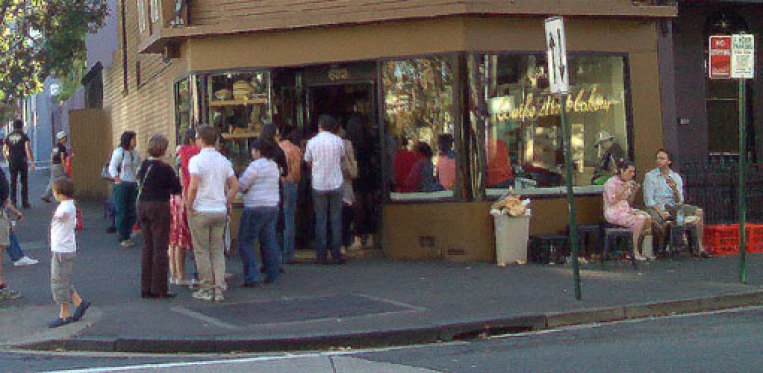
I was sitting in the park opposite the Bourke Street Bakery earlier today. It was nice just to sit in silence and watch the only place outside the former Soviet Union where people still queue for bread. It was just a wonderful moment of peace, a moment of quiet in an otherwise busy few days.
After the excitement of seeing Dave Mason at The Basement on Wednesday night, I had another night out on Thursday for the Australian premiere of the new Barry Humphries show. It was a star-studded night with celebrities galore. We were seated next to Ed Phillips (Temptation) and just behind Karll Stefanovic, Michael Willesee Junior and Tina Bursill. OK, so they weren’t big celebrities, and a few of them did leave at intermission…
That a few people left at intermission didn’t surprise me, as the first half featured Les Patterson and Sandy (the old bloke) whose black and morose humour is in stark contrast to that of Dame Edna, and was probably not what the majority of punters were there to see. Even at intermission, I didn’t really get the sense of a buzz from the audience.
Surry Hills must be the only place outside the former Soviet Union where people queue for bread.
That Barry Humphries received a standing ovation at the end was, I think more out of respect for a life-long career – he’s been doing Dame Edna for 50 years than in recognition of a great show. I mean, I’m a big fan, and have been to quite a few Barry Humphries shows in the past, but I was a little disappointed.
The following day at work I was discussing this with some people who had been there who enjoyed the show much more than I did. When I admitted I was disappointed with the same old jokes, a colleague reminded me that when you go and see a band you know incredibly well you get angry if they DON’T do the same old songs, a fairly spurious argument in my view.
At the end of the night, Graeme and I went for a drink at the nearby Irish bar which regularly changes its name. We then wandered along the street where I pointed out the location of the hairdresser from hell and noticed the anti-shooting up blue light at the entrance of a nearby backpacker hostel. Oh Sydney, you have changed.
And then last night, Colin and I went to Sydney Theatre for the final in the current season of Up Close & Musical. The lead act was Simon Burke who I thought was absolutely tremendous, basing his act around the children’s television series, “Play School” in which he regularly features. There were love songs to Jemima and Humpty Dumpty and he sang “I Don’t Know How To Love Him” to Big Ted… “and I’ve had so many bears before in very many ways, he’s just one more”. You couldn’t help but laugh.
I kept an eye out for Tyson who was apparently there but didn’t see him. Not all that surprising as UC&M was well attended last night. Hopefully, it will be just as popular, if not more so, when it resumes at the Theatre Royal when “Company” opens in July.
“For her first time in Australia, it would have been good to have some more of her older songs”, my friend said, as we made our way out of the Sydney Opera House tonight. I agree with that assessment. As much as I really do like her new material, it was classics like “Buffalo Stance” and (my personal favourite) “Manchild” that really got the audience excited.
I read with jealousy, Youssou N’Dour had joined her on stage at Womadelaide the other the day, performing their wonderful duet “7 Seconds”, and deep down I hoped he would have been there tonight also. It really is an amazing song.
But there again, Neneh Cherry is also an amazing performer. The show was full of energy and excitement, and even though she’s now 51 years old, retains a wonderful edginess. The drum and bass instrumentation of her latest work really worked for me, and I was amazed at both the sound, performance and graphical background to the show. I was also amazed at how good her voice is. In a 90-100 minute show, it never gave up.
“It would be genuinely ironic if we stopped to take a photograph of the sign and a coconut dropped on our heads”, I said to one of my fellow travellers.
Though I’ve been to Darwin many times I’ve never been to Bathurst or Melville Islands before, which are located about two and a half hours by ferry from Darwin. But this week I decided it was time, and so I booked a day tour.
Tiwi Islands coconut warningCrocodiles, stingers, and extreme currents, which explained why there was “no swimming”.
“My mother was taken by a crocodile” one of the grannies who was demonstrating pandanus weaving told us.
I would have liked to have shown you a photograph of the three wonderful women, but was told they preferred not to have their photographs taken. Any of the photographs you’ll see on this blog entry were taken and shared with the permission of the people they feature, notably Freddie, our tour guide. “Take as many as you want, he’s very photogenic” we were told, with a laugh.
We were also asked to be respectful of the cultural objects. For example, we were asked not to take photographs of the totem poles in the cemetery. And in one of the galleries, there was a sign saying not to take photographs of the arts and crafts, without permission.
“It’s okay, so long as it’s a broad general shot”, I was told when I asked for permission to take a photograph of some of the carvings.
Though I have a memory of experiencing this in the past, I had genuinely forgotten until today that in many traditional communities, people will often avoid eye contact with you. We were told today this is especially the case between brothers and sisters. After puberty, brothers and sisters are separated.
Though I can’t be 100% sure, it sounds like many of the cultural laws derive from concerns about interbreeding.
There’s a story in the museum which tells of what went wrong when a brother was attracted to his sister.We also learned about the four “skin groups” (which you inherit from your mother), and why you can’t partner with people from particular groups.
The tour guide, Freddie also explained how people from the Tiwi Islands are very different in many ways from people who live on the mainland, on Larrakia Country. For example, they don’t use woomeras or boomerangs.
Freddie, our tour guide was EXCELLENT. As he painted ochres on his face (an owl), he explained he learned the design from his father and grandfather, who also painted the same design. His sons will also inherit this design, he added.
“We used to do this by staring into the reflections in the water, but now we use mirrors. It’s much better”, he joked.
The story Freddie told, of the arrival of Christianity on the Tiwi Islands was a fascinating one. Freddie explained that religion is still very important on the island, but that it was a blend of Christianity and Tiwi Island traditions. You can see it in this image from the old mission church.Traditional art on street poles.
To be honest, I was a little sceptical about doing one of those “big tours” through AAT. In my heart, I wanted to do something a little more “grass roots”. But I got to the point where I realised I didn’t really know what I was doing/researching, and so going with an organised “group tour” was probably the easiest/best thing for me to do. It was really good, thanks to the local guides like Freddie.
Having sat through the first half of “Chess” last night at Sydney’s Theatre Royal, I found myself repeating myself. “Chess”, the musical written by Benny Andersson, Bjorn Ulvaeus and Tim Rice in the post-ABBA years, has been staged many times since the debut CD in 1984. The London Production had a good long run, and the Australian run went okay, but it totally bombed on Broadway.
Every time it’s been staged, it’s been slightly different. They’ve often re-ordered songs, added dialogue, and sometimes they’ve had different characters singing songs previously sung by others. Last night, for example, the song “Nobody’s Side” was at the show’s conclusion, rather than being a dramatic mid-show number. Last night I confided to my friends attending, I felt like I was attending “Chess – The IPod Shuffle Mix”, as it differed so dramatically from the original, and much-loved debut CD. Chess fan Angus, however, reassured me last nights was a “fairly standard modern production of Chess”.
Chess at Theatre Royal, Sydney
And that’s when I began repeating myself. Two and a half years ago, when I made a trip to West Ryde to see an amateur production of “Chess”, at the time concluding…
It occured to me the reason why “Chess” has had only limited success is that it spends too much time early in the piece talking about the game, the history, the politics, when actually it’s the love story and the personal motivations that are the most interesting. If I was doing a production I’d chop out most of the first half and begin with “1956 Budapest Is Rising” as it’s from then onwards that you understand so many of the motivations – both personal and political – that govern the action of the characters.
And to be honest I still think that’s the case.
I really hated the first half last night. It all started early in the piece during the song “Merano” (set in Italy) as the audience noticed the backdrop was actually the Paris skyline. I was also totally confused by what was happening, as the songs and scenes jumped around. The one saving grace was the performance of “Anthem” by the actor/singer who played Anatoly. He was excellent.
The second half, however, was much better. There was a more consistent plotline, and the cast sang well, even if the choreography was a little dodgy. The actor/singer who played Svetlana was very, very good, and we were all impressed upon discovering it was her stage musical debut.
Fundamentally, though, “Chess” needs another re-work. At the moment, it’s still far too inaccessible, with too many “b-sides” and superfluous content that distracts from the main story and the great songs contained therein. From what I’ve read, the most recent Swedish version (released 2002) probably comes closest to achieving that balance.
I really love “Chess” and I hope one day they finally get it right.
When you become an amputee, you are immediately introduced to a revolving door of medical professionals: specialists, physiotherapists, and prosthetists. While these experts are incredibly skilled, there is a unique, almost unspoken connection that occurs when you meet a professional who truly “gets it” because they have walked in your shoes—literally.
In an episode of The Limb Shift podcast, I sat down with Jeremy McGrath, a man whose journey from a terrified child to a Paralympic athlete and professional Occupational Therapist (OT) offers a profound look at the “lived experience” of limb loss.
A Difficult Choice and the Journey to Recovery
Jeremy’s story began with a difficult choice. Born with a limb difference, doctors initially suggested amputation when he was very young, but the idea was terrifying. As Jeremy recalled:
“The doctors brought it up again to me. Probably I was about seven or eight or nine. I was pretty young and pretty, pretty horrified at the idea of it. Um, got pretty emotional. Didn’t want to do anything like that.”
However, the medical team explained that as he grew, his leg would continue growing and make his prosthetics “more unshapely heavy,” subsequently limiting his ability to run and remain active. By the time he was fourteen, having given up sport, Jeremy reached a turning point. He realised that delaying the surgery would only make things harder once he hit major life milestones like his Higher School Certificate (HSC), university, and his career.
“I just decided if I have to get this done and I want to kind of live a healthy lifestyle and not limit myself and get back to running and fitness, I just made that decision. I have to do it,” he explained. He placed himself on a waiting list and underwent the amputation at age fifteen.
The immediate aftermath brought a fresh set of physical and social challenges. Jeremy changed schools at the same time, spending three to four months on crutches while navigating an entirely new environment. Because his pre-amputation prosthetic relied on heavy strapping all the way up to his hip, his right quadriceps lacked strength, requiring rigorous pre- and post-operative physiotherapy.
Furthermore, the physical adaptation to the new socket was a slow, painful process. As Jeremy noted, “The swelling was really large and took a long time for that swelling to come down, so had quite a bit of pain in the shoe first adapting to that, um, that socket or that prosthetic.” It took a full twelve months before he could properly return to sport and fitness.
The Psychological Shift and Finding Rowing
While the physical recovery required immense patience, the psychological adjustment was an entirely different hurdle. During his teenage years, Jeremy battled deep insecurities and actively avoided drawing attention to his limb difference.
“Going through high school, I didn’t want my personality or everyone to just look at and identify me through my legs. So I actually wore through the whole of high school long pants. I didn’t like to really bring too much attention to it. Um, so yeah, I was a little bit insecure. Definitely.”
Before his surgery, Jeremy had spent ten years playing soccer, using his heavily strapped leg to “belt the soccer ball.” Post-amputation, he found that kicking a soccer ball with a prosthetic was vastly different: “Sometimes I would kick the ball and my leg would go flying further than the ball.”
Losing that athletic outlet left him adrift until his final year of high school in 2012. Watching the London Games reminded him of attending the Sydney 2000 Olympics as a six-year-old, where he had harboured early dreams of competing at the Paralympics.
Searching for an accessible sport, he looked into rowing, mistakenly believing it was strictly an upper-body discipline. He soon discovered that rowing is actually predominantly a lower-body sport driven by the initial leg drive. “I might not have chosen rowing if I knew that at the time, but I loved the sport,” Jeremy admitted.
Fascinated by the water and embraced by a supportive local club, his rise was meteoric. Training six to seven times a week and waking up at 4:00 am, he made his first World Championships in Amsterdam in 2014—just two years after picking up an oar—and ultimately competed at the Rio Paralympics in 2016.
At the 2014 World Rowing Championships in Amsterdam, Jeremy McGrath competed with Kathleen Murdoch (prefers to be known at Kate). Together, they won the silver medal in the Legs, Trunk and Arms Mixed Double Scull (LTAMix2x) event.
For Jeremy, the true value of the Paralympic journey was not just the elite competition, but the profound psychological transformation it catalyzed:
“The main thing I got out of that whole experience was… the confidence, the fitness, being able to feel confident in my body and myself again, even if I didn’t make the Paralympics. I think growing and building all that and growing as a person was probably more influential on my life than necessarily the Paralympics.”
This newfound confidence completely changed how he carried himself; the teenager who once hid behind long pants completely abandoned them, choosing instead to wear shorts exclusively.
Landing in Allied Health
Jeremy’s career path was heavily influenced by a compassionate professional at Westmead Children’s Hospital during his adolescence. He recalled a physiotherapist “who not only was a great physio, but she really was a support for myself and my mother… I really felt cared for by her.”
Though he originally intended to pursue physiotherapy, he narrowly missed out on entry and “landed” in Occupational Therapy, initially planning to transfer after a year. However, once he discovered the holistic nature of OT, he fell in love with it.
While physiotherapy targets specific physical functions, OT evaluates daily living occupations in their entirety—from morning routines and parental duties to employment, leisure, and mental health. “I felt like, oh, this is a real opportunity where I can help people with more than just build up their physical strength, but be able to get back to doing things,” Jeremy shared, noting how perfectly it aligned with his own life philosophy of refusing to be held back.
Now a practicing clinician, Jeremy utilizes his personal history to break down barriers with his clients. Within the National Disability Insurance Scheme (NDIS) space, his background gives him a distinct advantage in establishing rapport:
“I think a lot of my clients, uh, when they find out that I, um, not just work in the NDIS but am a participant in the NDIS, I think they, they take that on board as, oh, this person not just knows about OT, but actually knows what it’s like to be in my shoes, um, and to have walked in them. So I think it really helps me build that rapport and understanding with clients.”
The Reality of Practice vs. Personal Habits
As an OT, Jeremy’s day-to-day expertise involves executing functional assessments, modifying homes, and prescribing assistive technology. This ranges from minor items like reachers to major mobility aids such as lift chairs, scooters, and hoists. Yet, despite nearly a decade in the field, Jeremy remains incredibly candid about his own shortcomings and the enduring pressure of maintaining a “stoic” persona.
Now in his early thirties and noticing the onset of back soreness, he has begun evaluating his own home for fall hazards, yet admitted that he does not always follow his own clinical advice:
“I think I’m very aware of falls, risks and how easy it is to fall. And even right now, I do have some falls in the shower. Even though I am pretty fit, I can balance one leg really well. Um, I don’t necessarily follow the best practices all the time that I tell my clients to follow, but, um, I think, um, you just need to be open and understanding of how serious falls can be.”
He acknowledged that being a young man makes it incredibly easy to default to silence rather than reaching out. “Being a man, being a young man, I think I like to be pretty stoic and not ask for help. Yeah. I think if my wife is here right now, she would agree with me that often I don’t ask for help when I probably do need it,” he confessed, highlighting that coming to terms with vulnerability is a lifelong, unfolding process.
Advice for the Journey Ahead
Reflecting on the fifteen years that have passed since his amputation, Jeremy emphasizes that the absolute hardest part of his journey was keeping his struggles internalized. For anyone currently facing limb loss or navigating a major physical transition, his advice centers on breaking the cycle of isolation.
“Once again, I’m going to come back to being that stoic man. You often keep a lot of thoughts and challenges to yourself… But the more open you can be to the close people in your life, the more that these people can come and help. And you’re never in this by yourself. You know, um, even just in if it’s not just your therapist and, uh, your medical team around you, but your support networks or your family members, your friends, uh, all these people want to help you. Um, and people can only help if you’re, you know, brave enough to have those chats and let them know what you’re actually feeling and thinking and experiencing.”
Jeremy’s full, insightful story will feature in The Limb Shift podcast later in the year.
“Who would imagine you’d get so emotional about someone from 160 years ago?” Kerry O’Brien observed on tonight’s edition of “Who Do You Think You Are?” on SBS TV. The ABC-TV presenter was a little bit teary when reflecting on the plight of his ancestors. I completely understand what he was talking about, as I’ve often felt that way as I’ve researched my family history and have learned about ancestors I’ve never known.
The story that tears me up, every time, is the story of Ellen Laing. She was my great-grandmother, who was born in the small community of Towamba, not far from Eden on the NSW South Coast. Ellen had a relationship with, but never married, her first cousin, William Rixon. Willliam was born 1868 at Towamba (1868/902), the eldest son of Thomas Rixon and Jane Laing. They are documented to have had at least two children together, more likely four. Despite the relationship, on December 31, 1902, eighteen months after the birth of William Arthur (known as Barney), William Rixon married another woman, Bertha Mary Ramsay at Bombala Church of England (1047/1902). Throughout her life, Ellen continued to use the name Rixon, although her death certificate refers to her as Ellen Lang. Ellen appears to have lived a somewhat mobile lifestyle, as the electoral roles record her living in Bombala, Sydney, Lismore and Brisbane at various times. Ellen appears to have spent the last months of her life at Newintong State Hospital, which NSW State Records notes in these terms…
Although the residents of Newington Asylum were predominantly elderly, Newington and the other Government Asylums also assumed the functions of hospitals for the “ordinary pauper population” and for those with incurable conditions, or who required convalescent care, at one third of the cost to the Government compared to Hospital treatment.
Ellen died on June 16, 1950 (1950/009885) and was buried in a paupers grave in the Presbyterian section of Liverpool Cemetery. I never knew Ellen (as she died 15 years before I was born), but it’s certain to me her life experience influenced many of the decisions made my her children and grand children, and hence me.
Having worked for the ABC for many years, and having been asked on far too many occasions, “Are you related to Kerry O’Brien?”, of course I had to watch tonight’s program. The short answer to the question was always “I have no idea. It’s a pretty common name”. After watching tonight’s show, the short answer I am no confident is “No”. Even though O’Brien is an extremely common name, it would appear our ancestors come from quite distinctly different counties. Kerry’s ancestry is from County Clare on the West Coast, whereas my O’Brien ancestry is from County Meath, not far from Dublin. His ancestors arrived about ten years earlier than mine. They appear to have been fairly poor, whereas my appear to have been reasonably wealthy. His ancestors settled in Queensland. Although mine had intended to settle on the Darling Downs, they ended up on the NSW South Coast.
But there is a Queensland connection. Patrick O’Brien, the son of James O’Brien and Mary Smith who came to Australia in 1864, moved to Queensland and had a career as a horse trainer in the area around Woodford, north of Brisbane. There was also a connection in that both Kerry and I have ancestors who were on the Berry Estate in the Shoalhaven. But aside from that, there’s no apparent connection.
Even though we’re not related, it was a fascinating program to watch, and I felt it was especially interesting to watch Kerry, as someone who has spent his life as a journalist, bring a journalist’s eye to the primary documentation and interpretation presented on the program. In contrast to some of the other people they’ve featured who just say “wow”, Kerry’s eye was more critical, though not any less passionate.
Now, having scratched Kerry off the list of distant relatives, my attention now turns to potential cousin Joe O’Brien from ABC News 24 :)
There’s a stereotype that people from Melbourne tend to popularise that Melbourne and Sydney are somehow different: that Melbourne is cultural, arty etc and Sydney is a little superficial. Here in Sydney, we don’t give a second thought to any perceived difference… I mean, why would you bother?
While looking at the Sydney Morning Herald today I observed some interesting similarities and differences, in terms of what readers in both cities actually find interesting in their newspapers.
The most viewed story in Sydney concerned Australia’s controversial Miss Universe entrant, Erin McNaught, who has been handpicked to appear on one of America’s top TV talkshows with billionaire Donald Trump, while in Melbourne, it was a story about Oxana Malaya who learnt as a young child when she was brought up by a pack of dogs on a rundown farm near the village of Novaya Blagoveschenka in Ukraine.
The big issues for readers of “The Age” included the weather (surprise!) as Victorians awoke to the chilliest morning for almost 12 months, today, with temperatures falling well below zero in cold spots around the state. They were also interested in the story of a man who cut off his own penis in a drunken bet, and the discovery through Google Earth of a small-scale model of a piece of territory in China complete with snow-topped mountains, streams and valleys and the
Readers of the “Sydney Morning Herald” were also interested in the Google Earth story. There was also a big story about a stabbing, as an 18-year-old man was in hospital with a 10 centimetre cut to his throat after it was slashed with a knife in Sydney’s east this morning. Unlike our parochial cousins down south, Sydney-siders also had an interest in the Middle East crisis.
Both cities were very interested in the news that Jessica Rowe is pregnant and that speaks volumes too!
SMH and The Age
Goodness knows what I’ll see on the front page of “The West Australian” tomorrow.
Like this:
LikeLoading…
Related
4 Comments
Indeed, UC&M was packed. Tony Sheldon, several of the Pippin cast, Ross Coleman and Gale Edwards were all spotted. And of course I was there! I was smiling the whole way home. It was interesting to hear a song from each of the Wild Partys. I think, at least for me, the LaChiusa one that Sophie Carter performed, “Black Is A Moocher” was a stand out number. What a talent! I was also blown away by Tyran Parke’s backup singers.
I thought Kookaburra’s Pippin was the best version I’ve ever seen. It just seemed to “get” the material and almost made it flow. Fantastic night.
There is one other bread line outside the former Soviet Union! It is at the Italian bread shop on Ramsey Street in Haberfield. On a Saturday morning the line snakes out onto the road despite the three matronly and very efficient serving ladies.


Indeed, UC&M was packed. Tony Sheldon, several of the Pippin cast, Ross Coleman and Gale Edwards were all spotted. And of course I was there! I was smiling the whole way home. It was interesting to hear a song from each of the Wild Partys. I think, at least for me, the LaChiusa one that Sophie Carter performed, “Black Is A Moocher” was a stand out number. What a talent! I was also blown away by Tyran Parke’s backup singers.
I thought Kookaburra’s Pippin was the best version I’ve ever seen. It just seemed to “get” the material and almost made it flow. Fantastic night.
Agree with you about Pippin. I was disappointed with the reviews.
There is one other bread line outside the former Soviet Union! It is at the Italian bread shop on Ramsey Street in Haberfield. On a Saturday morning the line snakes out onto the road despite the three matronly and very efficient serving ladies.
Ellen – Oooh sounds like my kind of bread shop! See you tomorrow.