The world is in a state of unprecedented flux, far exceeding the complexities of the Cold War era. This was the stark message delivered by New York Times journalist David Sanger in his Sydney University talk, “Election Watch 2024: New Cold Wars in a year like no other,” hosted by the US Studies Centre, which I attended tonight.
Sanger, in Australia to promote his book “New Cold Wars: China’s Rise, Russia’s Invasion, and America’s Struggle to Defend the West,” emphasized the plural form of “wars” to underscore the multifaceted nature of today’s geopolitical landscape.
For decades, the West operated under the illusion of inevitable democratic triumph, solidified by the Soviet Union’s collapse. However, the ascendance of China and Russia’s resurgence have shattered this complacency. Sanger argued that this naiveté underpinned Western foreign policy, particularly evident in Trump’s belief in transactional relationships with inherently “good” nations.
The world now navigates a complex trilateral dynamic involving the US, China, and Russia. The Russia-China alliance, a strategic partnership between former rivals, has emboldened authoritarian regimes like North Korea and Iran, destabilizing the global order.
Sanger suggested a covert US strategy to divide Russia and China while acknowledging the challenges. Biden’s emphasis on alliances, including the formation of a Pacific equivalent to NATO, contrasts sharply with Trump’s transactional approach, reminiscent of pre-World War II isolationism.
The Israeli-Palestinian issue also emerged as a point of differentiation between Biden and Harris, with the latter expressing more public criticism. However, Sanger affirmed continued US support for Israel.
The future remains uncertain, with nations like Australia caught between Western political affiliations and economic ties to China. The next few years will be pivotal in shaping the world order. Sanger expressed concern about the potential timeline for AUKUS to effectively counter China’s influence.
David Sanger (right), speaks at the US Studies Centre at the University of Sydney
It was a highly entertaining and thoughtful discussion, and a good way to spend a Monday night!
Today, I’m sharing an interview with former NRL referee Bill Harrigan from my own career archives, having worked in radio for a fairly long time.
I’m not too sure how many people outside of dedicated Rugby League fans remember Bill now, but back in the late 1990s and early 2000s, he was a legend—the face of refereeing in the game. When he released his autobiography, The Bill Harrigan Story, I interviewed him about his life both on and off the field.
🎙️ Summary of the Bill Harrigan Interview
In this interview, Bill Harrigan offers a rare perspective on refereeing Rugby League, explaining that he can’t enjoy the game like a spectator because he’s constantly focusing on rules and angles, noting that television angles often misrepresent his view. He addresses the public perception that he is “arrogant” and “up himself,” stating that his autobiography was intended to change that view by revealing his background as a police officer and his personality. Harrigan recounts a terrifying experience in 1985 while serving with the Tactical Response Group during the Bathurst bike riots, where he was fire-fighting police officers hit by Molotov cocktails and had to run for his life after chasing a rioter. He clarifies that he left the police force not due to fear, but for the opportunity to become a full-time referee in 1995. Finally, he shares the humorous anecdote of appearing on the dating show Perfect Match in the early eighties to win a travel prize, admitting he and his match “spiced it up” for the cameras even though he was seeing someone else. He concludes by expressing concern about his career prospects after retirement, noting the financial necessity of finding a new job immediately.
🎙️ ABC ARCHIVES: Interview with Bill Harrigan
Bill Harrigan: First. I’m involved in the game that much that it’s a methodical thing where I’m just going through the rules and watching the play and calling the shots and all that sort of thing. So I don’t get to enjoy it like a spectator does in the grandstand all back in, you know, sitting in their lounge room. And that’s why I’ve got to go home and watch it. And I haven’t had an opportunity yet. I’ve been too busy since the grand final. But in saying that too, I get a whole a different view to what you do. And a lot of people make this mistake. They go, oh, why didn’t he see that forward pass? But they’re seeing it from the camera angle or from where they’re sitting in the grandstand. Now, when I’m down on ground level, I’m looking through I’ve got a different angle completely. So I’ve got a different perspective of it. I’ve got players in front of me. Um, I may be looking at something else and just miss something. And yet people say, oh, how could he miss that? But they’re seeing a completely different angle to what I am.
James O’Brien: Do you ever get confused by what’s going on? Do you ever find yourself thinking, hang on, stuff’s going on here. I don’t know what’s going on.
Bill Harrigan: You do that sometimes if you get a pinball effect. And that is when someone kicks the ball and then it hits somebody and it ricochets off him and hits somebody else and then hits somebody else, and then all of a sudden somebody’s got the ball and running and you’re thinking, what happened there? And then you quickly replay it back in your mind and you go hit him. Went to him, went to him. It’s okay. Play on or you go knock on.
James O’Brien: So even though if it’s not immediately obvious, you still can sort of recount things.
Bill Harrigan: Yeah. The biggest thing is to try and get it right. And so sometimes you may have a, it might only be a second, second and a half delay in making a decision, but that seems like an eternity to everybody else because you’re thinking, jeez, he blew that whistle late. What’s going on? But what you’re doing is you’re replaying it over in your mind and you’re going, bang! Yeah, that happened, that happened, that happened. Oh yeah. Play on or do this. And that’s why the delays there.
James O’Brien: Now you’re out and about promoting your autobiography. Why do you think people want to read the Bill Harrigan story?
Bill Harrigan: Um, well, I’m hoping I’ve got a profile big enough and people are interested enough to pick up the book and have a look at it. And when they do, and they read about it because it’s not just about football and about my refereeing days. It’s about days in the cops and growing up and my beliefs and that sort of thing. But I think the biggest thing that I’m trying to achieve there is there is a perception of who Bill Harrigan is or who I’m like.
James O’Brien: What do you think the perception is?
Bill Harrigan: Well, the perception is that this bloke’s up himself and he’s arrogant and all that sort of thing. And and my wife had that at the start with the guy who wrote the book with me, Daniel Lane. His attitude was, yeah, this this bloke’s Hollywood. He’s certainly changed. When you pick up the book and you read it, I think you’ll change your opinion.
James O’Brien: There are some really interesting little bits of trivia in the book that I came across. I mean, obviously we know the big picture story, but there are a couple of nice little stories that I hope you might tell. Uh, in the mid eighties, you were part of the Tactical Response group of the New South Wales Police. You were in a pretty dangerous situation in Bathurst at Easter with the bike riots. Can you explain what happened there?
Bill Harrigan: Yes. Nineteen eighty five Bathurst bike races. And every year it’s. And it’s not bikie gangs either. It’s just bikers who go up there and some of them then drink too much. Think okay, let’s have a bit of fun. We’ll go out and we’ll rock the police compound. And so they start rocking it with bottles and rocks. Then it becomes Molotov cocktails and soaked toilet rolls and petrol. So they’re all flaming on fire.
James O’Brien: How old were you at the time?
Bill Harrigan: Um, back then, I was twenty five years of age, and I’d been, uh, two and a half, three years in the elite Tactical Response Group. I was in that from day one when it first was put together. Um, we’d trained for it. We got called up to help protect the twelve police officers that were just up there roaming the, you know, the hill and policing the hill just as they normally would. Um, they come under fire. So we got called up there. Out we went. By this time, there was a crowd of, you know, around four thousand people had surrounded the compound and the compound was on fire. The roof was on fire. They were out there trying to put that out. There was bottles and rocks being slammed all over the place, and we had to run out and try and stop the crowd from attacking the compound and just disperse them.
James O’Brien: How scared were you?
Bill Harrigan: Well, I was packing it. Yeah, absolutely. packing it. And, um, you know, you can put a lot more blunt than that, but we won’t. Um, but I was very scared out there. I was fearful for my life. Because in the end, as things happen, I got blokes standing beside me getting hit with Molotov cocktails. And the first hour and a half I was the fireman of of a particular line which had twelve fellows in it. If a molotov cocktail or a firebomb come over, I would run to where it looked like it was going to land. If it landed amongst our team, we wouldn’t break our line. You had to stand there and and cop it. So when it shattered, the petrol would flame and it would engulf that person. So we had fire resistant uniforms and everything on, but you still were lit up. My job was to straight away douse him with the extinguisher, put him out, and then if he had got on me, then whack it off on me as well. So that’s what I did. For the first hour and a half. One police officer, he panicked. He turned and ran. He broke the line and was running away. And I had to chase him. You can see me on footage running after him, um, trying to put him out with this extinguisher. Then after that, I went off the fireman’s position for other reasons, and I come back out into the line. And then we were called to charge, and we’d charge forward and move the crowd back, and then we’d have to regroup when we heard the whistle. And on one occasion, there was one guy who was urinating in bottles, throwing him at us, hitting us. Coppers were going down left, right and centre from this guy, and two of us chased him and we got that close to him when we heard the whistle blow to come back and reform. And both of us thought we’ve got him. And so we just went that a little bit further, chasing him, and all of a sudden we’ve chased him too far and we found ourselves amongst a crowd that then turned on us, and we end up having to run for our lives.
James O’Brien: Was it incidents like that which convinced you to leave the police force?
Bill Harrigan: No. I only left the police force eventually because I was offered the job full time refereeing. And that was something.
James O’Brien: That because you were doing part time refereeing at this stage, weren’t you?
Bill Harrigan: Yeah, I was still part time refereeing, and that was back in eighty five. And I went full time in ninety five.
James O’Brien: Was it was it a hard decision or. Um.
Bill Harrigan: No. It was. Well, yeah, it took a long time. But in the end I always I thought I was juggling refereeing and family and police work. So at the end of nineteen ninety five, I was going to retire. All I wanted to do was have one year with the new expanded competition. Because Perth had come into the competition, Auckland had come into the competition, then Super League came along in ninety five and offered full time work for referees. And so I said, yeah, that’s me. I want to have a go at this. And then I didn’t have to juggle everything around.
James O’Brien: The other bit of trivia I found from reading your book is that you were once back in the early eighties on the notorious TV show Perfect Match.
Bill Harrigan: Yes, I.
James O’Brien: Was. And you were picked.
Bill Harrigan: And I was.
James O’Brien: Picked. Okay. Can you tell us what happened there?
Bill Harrigan: Yeah, I went on that, and that was well before I was a first grade referee. So I was just unknown back in those days. But I went on I had the travel bug and I thought, yeah, I’d love to go on this. And they’re giving prizes out to travel to Bali and cruises and all that sort of thing. Why not? Yeah. So I’ll go on it. I went on there, fortunate enough to be picked, had a weekend trip to Bali, um, came back, told our story, went back on the show, ended up being the perfect match. As far as the Dexter rating goes with Wendy, the girl that chose me. We had a seventy five percent match rating, so we got an extra prize. We got one stereo system each, and I just thought the whole thing was fun and it was a great time.
James O’Brien: But you were seeing someone else at the time?
Bill Harrigan: Yes. So I had another girlfriend and I met her after I’d already applied for the show. And so I said, look, I’ve applied for this perfect match, so, you know, should I go on? And she said, yeah, that’d be great, go on and have some fun. So I did go on it. And when we came back, Wendy and I did say, look, ten couples go away each week. Only five get back on the show to tell their story. If we don’t get on, let’s make it. We really didn’t get on. So they want us to go back on the show. And if we do get on, let’s just spice it up a little bit to make it look like we really did get on well. So we still get on there to get the next prize. Yeah. Um, we got on, so we spiced it up, but it was just too spicy.
James O’Brien: See the showman even then, weren’t you?
Bill Harrigan: Yeah, I suppose so.
James O’Brien: Got me in terms of your future. Now what? After you retire from being a referee.
Bill Harrigan: If I decide to retire in the off season, which is what I’m contemplating, whether I come back again for another year or not. Um, I hope that there’s something out there for him in the media. I really I’m at a loss because I had seventeen and a half years in the police. Um, I’ve given that away and I’m thinking, okay, what am I going to do now? And, you know, the money that I’ve earned from refereeing is not enough to turn around and say, hey, I can give this one. No wonder I’m nowhere near what the players earn. So I have to get a job. So as soon as I retire, I’ve got to go and get a job. Otherwise mortgage and food on the table and everything just goes out the door. Um, so I’m just like anybody else there. What I’m going to do, I don’t know. And certainly that will come into consideration.
You know those stupid machines at the supermarket deli where you’re given a number and have to wait your turn, even if there are only two or three other people waiting? Minutes go by (it seems like hours) while your eyes remained focussed on the display above as you wait for your number to be called.
My Swedish teacher, Marianne once joked she thought they HAD to be a Swedish invention. Of all the countries in the world, the Swedes seem the most inclined to form queues without thinking twice about it. Here in Australia, we’re also very egalitarian, but we usually tend to get a little grumpy when it comes to queues, and of course, we “don’t like queue jumpers” :)
My most famous memories of waiting in queues in Sweden were on a Saturday afternoon minutes before the closure of the state-run bottle shop, Systembolaget, and in a phone shop.
In Sweden, there’s a government-owned monopoly bottle shop chain called Systembolaget, which operates with restricted hours. On weekdays, it’s normal trading hours; shorter hours on Saturday; and they’re closed Sunday. At night, bars also have limited trading hours with many closing at one, others at three.
And as much as I like to think of myself as a bit of a libertarian, I’m beginning to conclude these restrictions might actually be a good thing. By putting a limit on the hours in which you can purchase and consume alcohol, I think there’s more of a chance that people will go home to bed, as opposed to the all-night temptation offered in Sydney.
Although Systembolaget now operates like a supermarket chain, it wasn’t so long ago that you had to go in, make an order for what you wanted, and then wait for someone to bring your order out to you. There’s a few of these older style shops still around, apparently.
Systembolaget Södermalm
As for the phone shop, I also remember vividly waiting with Graeme in a queue in Stockholm. We were the only people in the queue, but we were still forced to go through the farce of waiting as they called out the numbers of people who were “before us” in the queue, but who had obviously already been dealt with. “77, 78, 79, 80”, the assistants called out the numbers, as if in a scene from Monty Python, looking around to see if any of the other people might have been hiding, until finally our number was called out.
Queuing for nightclubs in Sydney has for many years been a real joke. On NYE especially, nightclub bouncers make on with the pretense their club is full, and people are thus forced to wait in a lengthy queue down the street when mostly they’re only half-empty. It’s all about making the nightclub look to the potential customer as somewhere they simply must enter since, after all, there’s a queue.
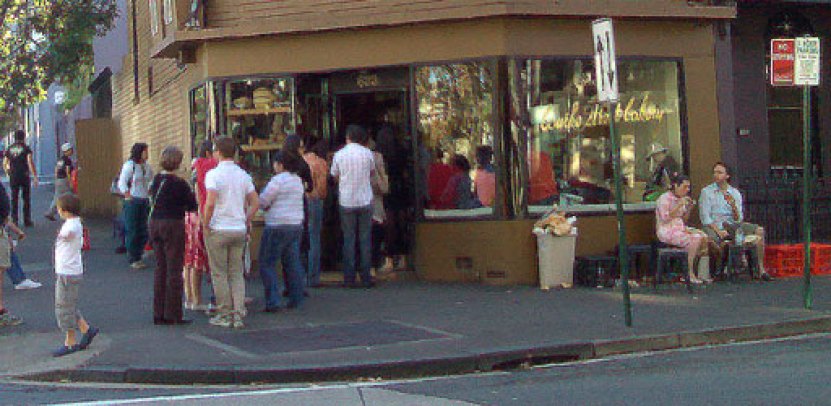
More recently, places like the Bourke Street Bakery (not far from where I live) have also become regular spaces where people will queue. I kinda understand it there, as the shop is very small, but I still think it’s bizarre that people will queue for bread. I mean, it’s Sydney; not 1976 in Poland.
Surry Hills must be the only place outside the former Soviet Union where people queue for bread.
The latest crazy queue in Sydney is the ice cream queue. There’s an ice cream shop in Darlinghurst where there’s regularly a queue of 50 or 60 people waiting. “It’s fucking ice cream”, a friend of mine observed last night, wondering why people would be prepared to wait 20 to 30 minutes in a queue.
Queuing for Ice Crime
The similarities between Sydney and Stockholm seem to be increasing every day…
I spoke on ABC Radio late tonight from China. As the transcript below explains, the program often features chats with ABC colleagues on their international travel. For my story, there was an added interesting angle: this was my first time travelling overseas as an amputee.
ABC Radio Nightlife Travel
Suzanne: You know, we like to chat to people around the world and people who go travelling around the world, and when any of our ABC colleagues happen to mention they’re going somewhere interesting, we’re always bugging them to chat to us from whatever location they’re in. And so it is that we come to speak tonight to James O’Brien who’s, well, one a very long-standing colleague of ours here at the ABC. He’s in China at the moment, and he’s joining us from China for a chat about what he’s been up to. And particularly as James has acquired a physical disability since the last time he went overseas, so it’s the first time he’s been overseas in this kind of new world that he’s inhabiting. So it’ll be really interesting to find out what that’s been like and what kind of challenges that’s presented. Hey James, welcome.
James: Hi Suzanne. I’m in a place called Wuxi in China. It’s quite a small town. It’s only eight million.
Suzanne: Right, small by Chinese standards.
James: Correct, yeah.
Suzanne: All right, so well I guess tell me why are you in China? What’s inspired you to go there?
James: Look, two years ago I went on an overseas holiday and I came back with an infection which led to a lower right limb amputation. And I’ve always been a great independent traveller. I love travel. I love overseas travel. And so I thought after a couple of years of rehabilitation it was probably time to think about what I could actually do. And I saw an awesome cheap deal to travel to China, and I’m sure lots of people have seen those ads, but I’m doing one of those tours. I chose this one for a couple of reasons: one of which is it’s super cheap. Secondly, because I’ve been to China twice previously, I thought if I go somewhere that is familiar and that I can prepare for, this overseas holiday on a group tour – but by myself, in a sense, as someone now with a physical disability – will be the way to go.
Suzanne: So what did you have to think about James when you were planning the trip that you’d never had to think about before?
James: Okay, so a bunch of stuff that I had to think about. First of all, to do some preparation. So I have a fortnightly session with a physiotherapist, so we’ve been talking about what I would need to prepare for this, and one of which is how many steps I would take every day. So normally I would take maybe seven or eight thousand steps each day. There was one day this week where we did 18,000 steps.
The other thing I needed to think about too was maybe cobblestones and uneven surfaces. So for example today we went into an old town called Suzhou in China which has lots of cobblestones, and also getting on and off boats, so I had to think about those sorts of things. I had to think about going through airport security, due to the fact that I not only have a prosthetic limb but I also, after a fall a few months ago, now have a full hip replacement – so you know, it doesn’t stop there.
So I had to think about those sorts of things. And for that in particular, I had to consider the size of some of the airports I’d be navigating, as some of the Chinese airports are pretty huge. And so the advice I was given was to ask for wheelchair support at the airport. So I was able to get wheelchair support at check-in at Sydney airport that took me through security, all of those sorts of things, all the way to the plane.
And then I think I also had to have a bit of a deep think for myself in terms of being on a group tour. So one of the things I was worried about was being maybe a bit of a burden. And I know that’s not a very good way to feel about having a disability, but I was worried that I would be slowing down everyone else and that I would be on the trip causing drama for people. So I had to think that really strongly through: whether or not I wanted to do this for myself, but also about the impact I might have on others.
Suzanne: Yeah, and so when you were booking the tour, were there some of those conversations you actually had with the company that you’re going with?
James: Yeah, absolutely. I explained the situation, and then I also explained to the airline I’m flying with. I rang them up and I said, first of all, that I need to get an aisle seat because that’s so much easier for me to get in and out of, and that I would like to have that seat all the way through. And they said, “What sort of disability do you have?” I told them what it was, hilariously, and they said, “Is it permanent?” I said, “Yes, it’s not growing back.” So yeah, I had those conversations all the way through.
Suzanne: Wow, did you find though, once you kind of took the initiative there and did that, James, that you were able to ensure that everything worked smoothly? Or were there some points you arrived at where you thought, “Well, no one’s handled this,” or, “Now I’m in some trouble?”
James: Yeah, but one of the things I also did was a lot of research beforehand about the hotels where we were staying – things like where is the nearest shopping centre, where are the nearest restaurants, all of those sorts of things. So I did more research than I would normally do, just so I knew, for example, where I’m staying tonight there was a shopping centre across the road, so I was able to go over and get a few things earlier tonight, which was good.
There were things that I’ve been very lucky with. So for example, when I have a shower, I generally speaking sit on a plastic chair because taking my prosthetic limb on and off is, you know, it’s hard. And so when I have a shower, I sit down, and then I have to put the limb back on and so on. So, at one of the hotels, for example, I showed them in Chinese characters that I’m an amputee and needed a shower stool, and I was able to get a stool within, you know, half an hour, which was great. But the hotel I’m staying in tonight, they said they just don’t have this at all, so that’s sort of something where I’ll have a shower tomorrow night, fingers crossed.
But then the other thing is too, you know, just keeping an eye out for things. Like, there are lots of things in Australia we see now all the time – there is always a wheelchair ramp, there are always lifts close by, and all those sorts of things. So many of those things don’t actually exist in China to the same extent they do in Australia. So there have been a couple of times when I’ve, you know, had to really go slowly upstairs or downstairs and so on. So there are a few little things, but then there are some things I just didn’t know would happen which are really positive.
So for example, Tiananmen Square and the Forbidden City – we went there on Wednesday and managed 18,000 steps. It was also quite a warm day, and I found that it was quite hard going, to be honest, but I managed to get through it. But there were three older people on the tour who were able to get wheelchair support. So as part of our group – there were 40 of us in the group – there were three people in wheelchairs, and they paid for that, you know, out of their own money, but that was something which I didn’t know that you could get. Halfway through the day, I thought, “Well, maybe I should have got the wheelchair support,” but you know, in the end, it was fine.
Suzanne: You did your 18,000 steps! So James, let’s now talk about some of the things you’ve seen, because I know there’s a great big Dragon Boat Festival on at the moment. Tell us about that and what you’ve seen of it.
James: Okay, so it’s a national holiday here in China at the moment. It’s the Dragon Boat Festival. And look, I’ve seen Dragon Boat races and all that sort of stuff in Sydney, but I didn’t even actually know what the Dragon Boat story is. So the Dragon Boat story is this, and it’s really interesting: a couple of thousand years ago, there was a Chinese poet who was feeling quite disillusioned about the government at the time, and who threw himself in the river and committed suicide. And so what the Dragon Boat Festival reenacts is a search for his body. And what they also do for this holiday is that they eat sticky rice. So they throw the sticky rice into the water so that the fish will eat it and not his body. So it’s a really – look, I didn’t know that story before.
So that’s happening today. There were huge crowds; we were in a city called Suzhou earlier today, and the crowds were pretty intense. It was pretty much like any Australian sort of public holiday. You know, lots of people out, eating all sorts of things. It lacked the level of alcohol consumption that I think we often have with our holidays here. But you know, there’s some great food. I had some Shanghai dumplings for lunch, and you know, so it’s a really great festival. It’s a three-day festival, and basically, all it means is that, you know, government departments are closed, some of the bigger shops, some of the small shops are closed. But at the supermarket, at the shopping centre near where I’m staying tonight, everything was open, and it was huge.
Suzanne: Now James, you mentioned you’d been to China a couple of times before. We’re talking to James O’Brien, who’s one of my colleagues here at the ABC. Has it changed a lot from the couple of times that you’ve been there before?
James: Yeah, a couple of things are quite different, just for me as someone living now with a physical disability. So I walked the Great Wall of China twice before, and you know, when I was a youngster I could get up the hill and, you know, do all sorts of crazy things and go through various forts and so on. I just couldn’t do that this time because it’s just physically so much harder for me – for instance, at the Great Wall, there were lots of steps I couldn’t manage this time, but it was still a terrific experience.
So, you know, being a little bit older, I just took a more sanguine attitude towards things, to say, “Well, I can’t do that anymore. What can I do?” And I can do the smaller things, and there’s great pleasure in the small things, I think. So for example, I had one young guy, an Australian guy actually, say, “Hey mate, you’re fantastic, that’s so good that you’re doing this.” And I said to him, “The best thing is you take it more slowly and you see a lot more.” So I think that’s a really interesting thing about the times before when I’ve been here. Taking it more slowly, you see a little bit more, which is good. And also you chat to more people along the way than if I was trying to run to the top of the hill, you know, in some sort of race with everyone else.
The other really interesting thing is money. So for example, it was very much a cash society when I was last here in 2014, and it’s now very much a cashless society. So for example, I think I might have paid cash maybe once in the last few days because I couldn’t use my Alipay. So Alipay is an app, and there’s also a WeChat app, and you link your credit card to them and you just pay through scanning. Look, it’s not dissimilar from tap-and-go, but that’s a significant change here.
The other really significant change I think I’ve seen is electric vehicles everywhere. So you know, 10 years ago there were lots of cars, diesel, pollution, noise, and so on. So some of the cities we’ve been to over the last few days have been rather quiet because it’s all electric vehicles.
Suzanne: Wow, because we know China’s making a lot of them, James.
James: Yeah, we know China’s making a lot of them, but they’re driving them too. Yeah, I also noticed, I mean, so far we’ve been to Wuxi, Suzhou, and Beijing, and there are fewer bicycles and more motorbikes, is an observation I would make. And also lots of flash cars too.
Suzanne: James, thanks so much for joining us from China to tell us a bit about your trip and just, I guess, the experience of getting out there in a kind of very different phase of life. Does this give you more confidence that you’ll go travelling more overseas in the future again?
James: Absolutely. And there have been two other people on the trip, two women who are in their late 70s, and, to be honest, they have physical health problems themselves. They’re both quite overweight with limited mobility and so on, and they’ve been really quite inspiring. For instance, I was chatting to them today, and they’ve plotted out travel for the next two or three years. So yes, it gives me confidence that I can do it, that I won’t be a burden on other people. But it’s really important just to research and to talk to people and to get some sense of what you’re getting yourself involved in.
Suzanne: Well James, we will hear more when we see you in the office again, but thanks so much for sharing a bit of your story with our listeners tonight.
“Naboer” (“Next Door”), is one of the most disturbing and scarey movies I have ever seen. Having just finished watching this Norwegian film on Foxtel’s “World Movies”, I’m still a little “on edge”, which may or may not be a good thing for a Sunday morning.
The film starts off simply enough, with the character of John being approached by his neighbour to help move furniture. It soon becomes evident, however, the woman and her “sister” have something more sinister or sexual in mind, when it becomes clear they have been “listening in” to John’s life through paper-thin walls. Seduction occurs, but not as you would expect, with accompanying violence. As the film progresses, John becomes more and more disturbed by the sexual violence he has committed, which in turn takes him into a world where he (and the viewer) finds it hard to tell reality from fantasy.
On more than one occasion, I found myself as confused as he was, as walls, rooms, and people appear, disappear and re-appear. That’s not to say the film is confusing, as it maintains an inherent logic, despite the lines of reality being so heavily blurred. On another level, the “rooms” are probably analogous for the different parts of John’s mind, which makes this such a thrilling movie on another personal and psychological level. While watching, for example, I was reminded of a recurrent dream I’ve had in my life, where I “discover” some hidden rooms in a house, but which I never enter. But while it’s fear that keeps me out of the rooms in my recurrent dream, it’s curiousity which takes John into the rooms in this film.
What I guess is most disturbing about the film though, is that you could actually imagine this occuring, which is something which I thought was lacking in the other scarey film I recently saw, The Book Of Revelation. Highly recommended.
I love Dorothy Parker and I love Stephen Sondheim, so presumably if both were combined in a cabaret production I’d be extremely happy.
Colin and I found out about this production while attending a terrific play at The Stables called Strangers In Between. During intermission we got to chatting with a woman who was in the show called Buster Skeggs who seemed absolutely lovely. We exchanged cards and a few days later a brochure for the production arrived.
The basic premise for this production was that the words (and wit) of Sondheim and Parker would combine well to construct a narrative about a couple before and after their marriage.
Like Sondheim, Parker, who famously attempted and then committed suicide…
Razors pain you;
Rivers are damp;
Acids stain you;
And drugs cause cramp.
Guns aren’t lawful;
Nooses give;
Gas smells awful;
You might as well live.
has work which ranges the gamut of emotions… though not as she famously said, “the gamut of emotions from A to B”.
Sondheim also has work which ranges from the beautiful “Another Hundred People” which I’ve loved since I first heard it sung by Jodie Gillies to the terrific spoof on “The Girl From Ipanema” called “The Boy From … a little Spanish town called Tacarimba La Tumba Del Fuego Santa Maliga Sacategas Lo Onto Del Sol Y Cruz.”
The vocal performances ranged from ok to excellent… this show worked in so many ways.
Of course, I drink like a fish. But over time my body seems to have built up a bit of resistance, so I don’t often get hangovers. Today, however, was an exception: I woke with one of those mind-numbing hangovers.
Last night I went out looking for something to eat and headed towards the “gay area” of Tokyo. The first bar I called into (for a beer) had the best name for a bar ever: Cholesterol. And then it went on and on, met some lovely people, and suddenly it was 5 am.