“Do you mind if I sit down for a moment?”, I asked the woman sitting by herself at a table. “My grand-daughter’s just gone off to get some food, as I can’t get around much. But you can stay until she comes back.”, she said.
We started chatting about our lives, as you do. And when I told her what I did for a living, she asked if I knew such and such. “Yes, very well”, I told her. She then went on to tell me her husband had taught him when he and his family were living in Tennant Creek.
In the media, it’s common to try to pinpoint people you may have worked with. And, generally when you meet someone from a country town, and tell them where you’re from, the conversation of “do you know such and such” inevitably springs up. “People in cities ask you what you do for a living, people in country towns ask you where you’re from”, I’ve often noted.
I don’t know how many times I’ve been to Mindill Beach Markets in Darwin, but it’s quite a few. They’re most memorable for their food, and their sunsets. They also sell a lot of stuff which I generally describe as “stuff you can buy, but stuff you don’t need”. Well, aside from food, and today I enjoyed some pickled octopus and some home made sorbet.
I sent my friend Sue a photograph of the pickled octopus, as she and I are great fans of it. She’s coming to visit for a few days, is then headed on a tour to Kakadu, returning next week for some Darwin Festival and Art Fair activities with me.
One of the great things about Mindill Beach Markets is how people leave the markets momentarily to watch the sun set into the ocean. Taking photographs is something everyone at the markets seems to do.Though today’s sunset was good, for me it was nowhere as spectacular as the last time I saw it, last year, at low tide. How great is this photograph?
But of course, I’m here for work, and yesterday I managed to combine a bit of work and outdoors activity. A good mate from Sydney (a work colleague) is also here, heading off to the major Indigenous gathering, Garma.
The Drum in Darwin
The team from ABC TV’s “The Drum” is also going to Garma, and yesterday, they broadcast their program from the Darwin Waterfront.
Watching ABC TV’s “The Drum” go to air live from Darwin.Though it was a great show, we were slightly distracted by this going on in the background. Looks like such fun. They did it for most of the hour. Awfully tempting to join them.
Sue wants to know if we can do the same thing while she’s here. :):)
NOTE: This article is under constant revision, as new bits and pieces of information come to light. If you have any further bits and pieces of information to add, please contribute in the comments below.
The first words Colin Anderson ever spoke to me are etched in my memory. Colin, the Head of Drama at Charles Sturt University, had a presence that preceded him. With a career forged in the theaters of Sydney and London, his reputation, particularly at Sydney University, was cemented by his legendary performance of the song about the “Eternity Man,” Arthur Stace.
Eternity Documentary 1994 directed by Lawrence Johnston https://www.imdb.com/title/tt0109749/Colin’s life as “Wagga’s Mr Theatre” remembered in The Daily Advertiser (10-07-2014).
Newly arrived in Wagga Wagga, I was still finding my feet – literally. My temporary residence? Romano’s pub. Just a week into my new gig as the Morning Show presenter at ABC Riverina, I found myself at a party at Colin Anderson’s house.
I was a bit out of my element. “Who are you and what are you doing at my party?” he asked me.
Quick as a flash, I replied, “Gavin and Bryce brought me along. They said if I wanted to meet all of the interesting people in Wagga, I should get to know you.” A chuckle rumbled from his chest, and with a twinkle in his eye, he declared, “Good answer, you can stay.”
That chance encounter sparked a friendship that lasted for many years, right up until his passing. It’s a story I even shared at his funeral.
This was long before gay cafes, bars, or the internet. While LGBTQIA+ people certainly existed, social connections were often forged in private spaces, through invitation and word-of-mouth.
Seeking connection, I headed to the Victory Memorial Gardens, a park in the heart of Wagga. Even today, there’s a stigma attached to these kinds of “cruising” spots, often unfairly associated solely with public sex. But back then, they were vital meeting places for gay men in rural towns, spaces to simply chat and connect, especially during the warmer months.
That’s where I met Gavin and Bryce, who, in turn, led me to that fateful party at Colin’s.
1992 – SYDNEY GAY AND LESBIAN CHOIR VISITS WAGGA
What seemed like a typical choral championship became a national media sensation. The appearance of the Sydney Gay and Lesbian Choir, a newly formed ensemble still finding its voice, unexpectedly thrust the organizers into the spotlight.
Stephen Schaefer, the Sydney Gay and Lesbian Choir’s founding Music Director, reflected on the 1992 National Choral Championships in Wagga Wagga as a pivotal moment for the choir. “It was a coming of age,” he shared in a 2021 interview. Facing prejudice and controversy, the choir’s decision to compete under their own name, and their subsequent victory, solidified their identity and purpose. It was a defining moment not only for the choir, but for LGBTQ+ visibility in Australia. (Interview 31/03/21)
In a move that underscored the prevailing prejudices of the time, organizers of the 1992 National Choral Championships in Wagga Wagga asked the Sydney Gay and Lesbian Choir to suppress their identity by changing their name to the more ambiguous “Eastern Suburbs G & L Choir.
Wagga Wagga Daily Advertiser, April 30, 1992
Meredith Knight, the Sydney Gay and Lesbian Choir’s former Secretary, vividly remembers the tense negotiations surrounding the choir’s name leading up to the 1992 National Choral Championships in Wagga Wagga. As the person who filed the application, she had a front-row seat to the organizers’ attempts to pressure the choir into suppressing their identity. What compromises were offered? What strategies did the choir employ to resist? Knight’s recollections offer a fascinating glimpse into a pivotal moment in the choir’s history.
For one woman, the idea of the choir going to Wagga filled her with dread.
The moment arrived. The Sydney Gay and Lesbian Choir took the stage for their Wagga Wagga debut. Suddenly, a figure rose from the audience – Tom Hillis, a prominent local car dealer. He turned his back on the choir in a gesture of blatant disapproval. But then, a voice rang out, clear and defiant, “Sit down, Tom, you silly old fool!” Whether this heckle truly happened or is merely a cherished legend, it perfectly captures the spirit of defiance that permeated the air. And in the end, despite the protest and prejudice, the choir triumphed. They won!
“We got a positive reception from the Wagga people… They were very pleased that we were here; they were very pleased that we won,” a choir member shared on ABC Radio’s “The World Today” on August 31, 1992. This statement, however, presents a somewhat rosy picture compared to the experiences of prejudice and resistance the choir also faced during the Championships. It highlights the complex and often contradictory reactions the choir encountered in Wagga Wagga, a community grappling with changing social attitudes.Months later, the Sydney Gay and Lesbian Choir made a bold statement at the 1993 Sydney Gay and Lesbian Mardi Gras. Marching proudly, they declared themselves “Too Sexy for Wagga,” turning the controversy into a badge of honor. This playful act of defiance, captured in the film “Something to Sing About,” showcased the choir’s resilience and their ability to find humor in adversity.
The choir came back for the 1993 National Choral Championships to defend their title, and a film about that experience was made, to be released in 1995.
This is a short radio feature I made about the story.
1992 – FORMATION OF THE RGLSSG
The choir’s visit seemed to ignite a spark in the community. While the exact timeline is a bit hazy now, the Riverina Gay & Lesbian Support & Social Group emerged soon after, fueled by the excitement and sense of possibility generated by the Sydney singers.
Interestingly, one of our members, Peter Lloyd, revealed that this wasn’t the first attempt at creating a gay social group in Wagga Wagga. An earlier iteration, called “SWAG” or “South West Association of Gays,” had existed sometime before. Peter, with a mischievous twinkle in his eye, would often recount how he once deflected a curious inquiry at the bank about the meaning of “SWAG” with a sly, “South West Amateur Golfers.” His witty evasion speaks volumes about the challenges of being openly gay in those days.
Our inaugural RGLSSG event was held at Chris Jones’s farm, sometime in August, if memory serves. Chris, a Charles Sturt University alumnus and a rising star in the film industry, had generously offered his place. His house, a treasure trove of film props, provided the perfect backdrop for our gathering. But first, we had a farm to tame! Chris, busy with his film commitments (including a stint as the “animal department co-ordinator” on “Babe”!), had left us with a rather overgrown property. A weekend working bee ensued, with much grass-mowing and frantic tidying. As the day of the party approached, anxieties swirled. How many people would dare to show up? Would the police raid us? Those fears were real back then. But in the end, around fifty people arrived, and the atmosphere was electric with relief and joy.
FORMING A GROUP WASN’T EASY THEN
Richard Roberts, one of our early members and a social work professor at Charles Sturt University, captured the essence of our struggle in a powerful article titled “Men Who Have Sex With Men In The Bush – Impediments to the formation of gay communities in some rural areas.” Several of us were interviewed for the piece, sharing our experiences of navigating the challenges of building a community in the face of stigma, prejudice, and the devastating impact of the HIV/AIDS epidemic. Richard’s research shed light on the unique difficulties faced by LGBTQ+ people in rural Australia during those tumultuous times.
The Rural Outreach Project under the auspices of the AIDS Council of NSW is making an important contribution to facilitating the formation and consolidation of gay networks and organisations in rural NSW.
“Men Who Have Sex With Men In The Bush – Impediments to the formation of gay communities in some rural areas” by Richard Roberts, Rural Society Volume 2, Number 3, 1992.
THE ONLY GAYS IN THE VILLAGE
During my own initiation to the bush I was confronted by a solicitor (engaged for conveyancing) informing me that a senior manager of my workplace was ‘a practising homosexual’ and that he did not approve of ‘practising homosexuals’.
“Factors Influencing the Formation of Gay and Lesbian Communities in Rural Areas”, Richard Roberts, National AIDS Bulletin April 1993, Volume: 7, Issue: 3
Tony was born in Sydney in 1963 and moved to Wagga Wagga, a small town in regional NSW with his family six years later. After his parents separated in 1970 Tony moved in the public housing with his mother and his two younger siblings. Tony explains that while there was a strong Aboriginal community in Wagga Wagga but he was surrounded by white families and they never talked about being Aboriginal. Tony resented his hometown and endured racism and homophobia from other students “who made my life hell” during high school and concluded “out of Sydney it’s just a nightmare if you’re gay”
Group member, Tony Creighton in “HIV Survivors in Sydney: Memories of the Epidemic” by Cheryl Ware.
Incidentally, Tony who died in 2015, was also interviewed for a collection in the National Library https://catalogue.nla.gov.au/Record/6387184 (Recorded on 20 October 2013 in Darlinghurst, New South Wales.) Access closed until 2034. The book by Cheryl Ware also indicates Tony created a documentary, “Black & Out” which documented many of the experiences of Aboriginal men who are gay, which you can watch on SBS on Demand.
I am a 29 year old who wants to come out but doesn’t know how to go about it. My employment while officially recognising gays frowns strongly and prejudices harshly.
RGLSSG correspondence 1995
One night I was walking across the bridge over Wollundry Lagoon. Two drunk guys were on the other side of the road, and one yelled out look, there’s a faggot let’s go bash him up. They didn’t, but the fear was always there.
Allan, Wagga born, quoted in an exhibition about queer history at the Riverina Museum in 2017
MOMENTS FROM THE EARLY DAYS
The following years were a whirlwind of activity. We hosted a vibrant mix of events, from formal gatherings and lively parties to casual coffee meet-ups and thought-provoking discussions. Our community expanded beyond Wagga Wagga, forging connections with LGBTQ+ groups in neighboring towns like Griffith and Albury. For a time, a separate women’s group, “Women Out & About In Wagga,” flourished alongside ours. But we soon realized that unity brought strength and even more fun! In 1994, we officially merged, creating a more inclusive and dynamic community.
Some examples of newsletters of the Riverina Gay and Lesbian Support & Social Group
In July 1993, the renowned poet, Dorothy Porter began a six-weeks residency at the Wagga Writers Centre at Charles Sturt University. As a fairly well known lesbian at the time, there was a lot of interest around her residency, and she was involved in a number of events.
Sandy is attempting to organise a function so Dorothy is able to meet members of the region’s lesbian community. It will probably be in the form of a pot luck dinner.
RGLSSG Newsletter July 1993
In the Western Riverina people have been getting into the spirit of things by celebrating Christmas in June. A number of people made the long distance trek from Griffith to Ardlethan to attend a dinner early in June. In the Eastern Riverina, the mystery car rally found its way to another equally wintery spot, Adelong in the mountains. It was a wonderful afternoon culminating at lunch at The Old Pharmacy.
RGLSSG Newsletter July 1993
THE SIGNIFICANCE OF HIV/AIDS
In the early 1990s, AIDS was still a very big issue for our community.
Two members of the group have participated in the Aids Council’s Rural Outreach Training Project for Gay Men. Issues covered over the two day workshop, Covered, for example safer sex, listening skills, gay identity, beats and discrim ination. An informal gathering and much socialising over the weekend contributed to a sense of camaradare and helped to break down barriers. A highlight of Day 1 was an explanation of the mechanics of HIV, explained in a manner that was both detailed, yet understandable. The trainer also explained how drugs like AZT and ddI help combat the virus. A highlight of Day 2 was a frank discussion of beats in the country, their social and sexual roles. (It wasn’t long, however, before the trainer soon realised he was dealing with experts in the field !!) Another highlight of Day 2 was the opportunity to hear and share the experiences of three men living in the country who are HIV+. Only two days together, but a true sense of belonginess developed from share experience.
Glen Andersson in the RGLSSG Newsletter, December 1992
At the end of 1992, the AIDS Quilt came to Wagga and was hosted at the local office of ABC Radio.
PAULA DENHAM, has recently commenced work as the region’s Sexual Health Nurse. Paula, a registered nurse with six years experience, has been working in Sydney in HIV with gay men and intravenous drug users. She has also worked as a carer for people with HIV and has a personal interest in HIV/AIDS issues. “I have a couple of close friends with AIDS.” she says. She believes “informed choice” is the most important part of her job, giving people information, so they can make choices for themselves.
RGLSSG Newsletter, May 1993
Amidst the growing concern about HIV/AIDS, the local Health Department took a proactive step by establishing a community-based AIDS Task Force. I remember attending a forum chaired by Deputy Mayor John Harding in May 1993. A newsletter from that time paints a stark picture: 50 people in the South West Health Region had either fallen ill or died from AIDS in just three years. The forum, featuring keynote speaker Bill Bowtell, then National President of the Australian Federation of AIDS Organisations, drew a crowd of over 170 people, demonstrating the community’s deep concern and its willingness to confront the crisis head-on
One of the members of the group, Andrew Bishop from Cootamundra, had been living with HIV/AIDS for a number of years. After several years living in Sydney, he returned to his hometown. He wrote a piece about his experiences in the HIV/AIDS journal, “Talkabout”.
Most of the people that I came in contact with believed that the sun was setting, so to speak. I did not have much time left. Well I fooled them. I then joined the Riverina Gay and Lesbian Social and Support Group which has its headquarters in beautiful downtown Wagga Wagga. Just the name brings terror to ones heart. Wagga Wagga. I then attended their social event of the year. The Christmas party. That was fun. That was where I met the lovely Glen who was to become my friend and love. This opened me to the endless social events on the Riverina Gay and Lesbian Support Groups calendar. (These events being private and public). I quickly formed a group of friends. They are a good lot of fellas and girls, as we say here in the outback. But the support and help for someone positive like myself is minimal. I have been very lucky. But I have spoken to some boys in the area that feel lonely and isolated. We don’t have the support groups as Sydney has. Sure, you have family, friends and nursing support, but nobody knows how you feel until you’re there yourself. To be able to talk about your anxieties, fears and doubts to someone who knows.
Bishop, A. (1994), ‘A Wagga Boy’s Own Story’, Talk About, July, 30 – 31 (full article here)
Andrew Bishop, a member of the Riverina Gay and Lesbian Support and Social Group, proudly marching in the 1994 Sydney Gay and Lesbian Mardi Gras.
It was so nice to be reminded of those days and the amazing work you and the others did as well to support the development of the group down in Wagga Wagga. I think it is so great you are writing this piece and ensuring all the time, effort and good work associated with the group is recorded for history. It is important to validate gay history and especially so in rural and regional areas.
Nigel Carrington, former Rural Outreach Officer, ACON in an email, February 2021.
1993 WAGGA WAGGA GETS A GAY AND LESBIAN POLICE LIAISON OFFICER
Wagga is the latest in a growing number of towns to have its own gay and lesbian police liaison officer. The appointment of Kevin Nisbett (his name is not for general public consumption, but for the gay and lesbian community alone… we’re not sure at this stage why, though) was made last week by Chief Inspector, Kevin Wales. A consultant to the NSW Police Force on Gay and Lesbian issues, Sue Thompson, says the appointment recognises the growing and more visible community now found in Wagga. She says it is not in response to any specific concern raised by either the community or the police force. There are many officers now throughout NSW (including a female detective in Albury). Only once, says Sue Thompson, has an appointment “failed”. Although not knowing the officer personally she says, in general terms, the job goes to “a high ranking community-minded officer”.
The appointment of the officer was announced on Prime TV by Kevin Wales in terms of “a need to clean up Collins Park”. Sue Thompson has confided that she is disappointed with such comments and would be willing to raise the issue if comments like these continue. Within two days of the appointment, a “raid” was conducted on Collins Park. There was, apparently, only two people in the park (typical!!!) and they fled quickly.
RGLSSG Newsletter, May 1993
Sgt Nisbett reports the “in house discussions” were often heated, especially amongst the younger police officers. “The older police officers have been around, they are more understanding”, he said. There was, from sections, a lot of resistance to the appointment of a gay and lesbian liaison officer.
Kevin Nisbett was the first Gay & Lesbian Liaison Officer appointed to Wagga Police. RGLSSG Newsletter, June 1993
Over the next couple of years, the importance of gay and lesbian liaison officers increased, including the appointment of one officer who was actually the sister of av group member.
“I wanted to attend the forum to learn more about the community and to make myself known to gays and lesbians in the area. Because I was on annual leave, I decided not to go in uniform, – that was probably my biggest mistake”, says Constable Genevieve Graham. When the media gathered in the main street later that afternoon, one announcer happened to mention the words gay and lesbian as the TV camera panned across Graham’s face. Although the announcer went on to say “liaison officer”, apparently hundreds of Wagga residents had already gone into shock. Shock – that such a high profile person, a police officer and a former “Miss Wagga” might actually be a lesbian. For the next few months the young police woman had to endure speculation that she was “one of them”.“Pink Politics & Blue Uniforms” by Jo Clark, Lesbians on the Loose Volume: 6 , Issue: 3 (March 1995)
1993 – THE GAY AND LESBIAN CHOIR RETURNS
In August 1993, the Sydney Gay and Lesbian Choir came back to Wagga Wagga to defend their title
When this scene appeared in the 1995 film, “Something To Sing About”, I blushed. I was the radio presenter he was talking about!. (Used with permission of the film’s producer, Marguerite Grey) https://www.imdb.com/title/tt6573608/
Stephen Schafer reflects on the importance of the championships, to have fun, and on the ongoing interest in the choir in Wagga Wagga. (Used with permission of the film’s producer, Marguerite Grey)https://www.imdb.com/title/tt6573608/National Choral Championships, Wagga WaggaA still from the film, “Something To Sing About”, about the return to Wagga of the Sydney Gay and Lesbian Choir. https://www.imdb.com/title/tt6573608/
Sadly, this time around they didn’t win, they came third. But there was still a lot of joy in seeing them compete. The choir invited members of the Riverina Gay and Lesbian Support & Social Group back to a local restaurant to join with them in a joyous celebration of food and song.
Dinner at The Old Wagga Inn. As shared by Gary Procter on Lost Gay Sydney, celebrations in Wagga for the Sydney Gay and Lesbian Choir. That’s me, centre back, in the black pullover. And from Marguerite Grey, the producer of “Something To Sing About” (the documentary which screened on ABC-TV), “I am on the right hand side in the t-shirt with the name of the film on it next to the boom mic operator. The director of the film Martin Daley is in the left hand side of the picture next to Jo Parker on camera I think.” Thanks to David from the SGLC: “The documentary film on the Choir, Something to Sing About, was premiered at a special screening at the Academy Twin Cinema in Paddington on 19 February 1995. It was broadcast on ABC-TV on 1 March 1995 and went on to win the Rouben Mammoulian Award at the Sydney Film Festival in June that year.” https://www.imdb.com/title/tt6573608/
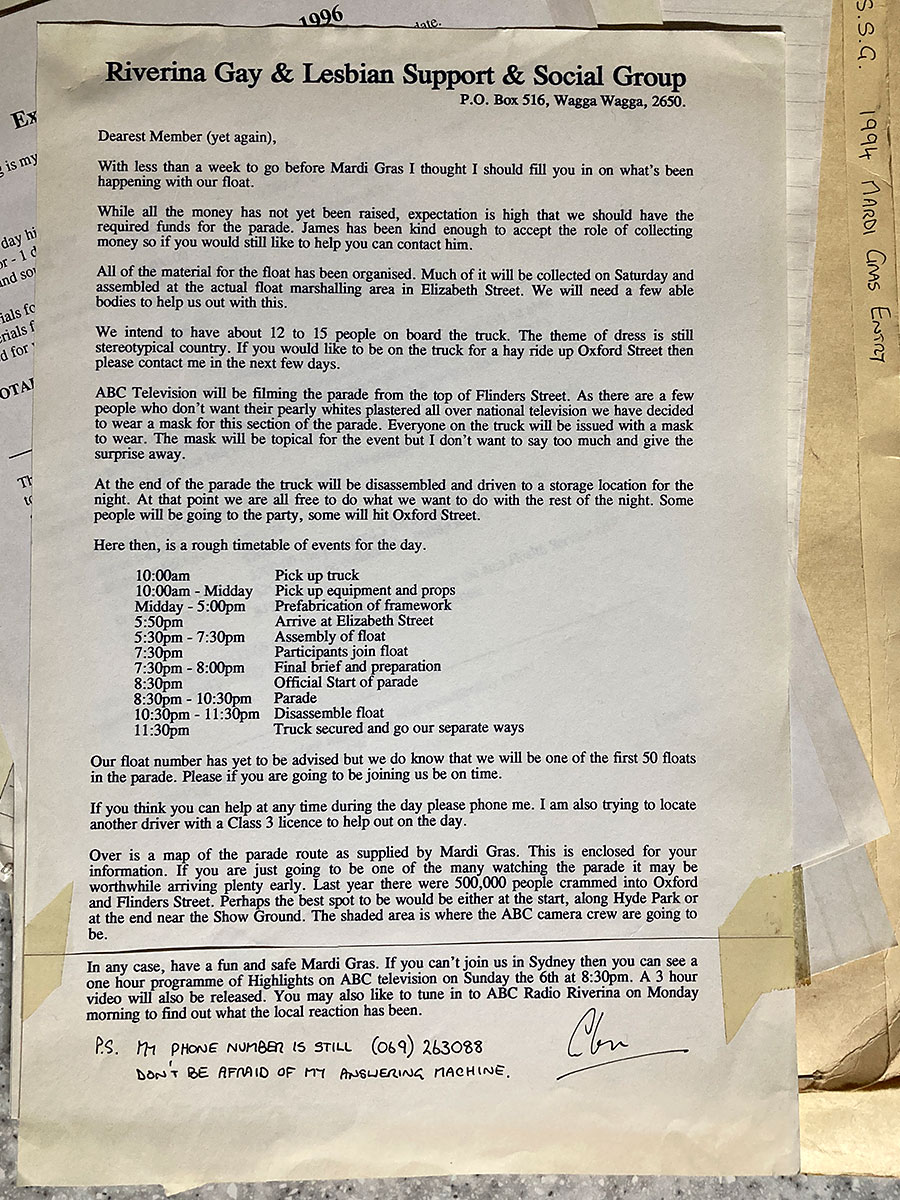
1994 – WAGGA’S FLOAT IN MARDI GRAS
Organising the Wagga Wagga float for Mardi GrasWith the ABC recording the Mardi Gras festivities for national broadcast, we faced a dilemma: how to protect the identities of those who weren’t ready to come out on television. Bandanas and low hats were considered, but then Michael McCormack, unwittingly provided a more creative solution. Ian ingeniously enlarged McCormack’s photo from the newspaper and fashioned them into masks, Mardi Gras style! While the intention was to provide anonymity, the excitement of the moment proved too much. Instead of hiding behind the masks, people gleefully waved them at the ABC cameras. Thankfully, as Glen Andersson recounts in his 1994 report for the RGLSSG, no unintended “outings” occurred on the evening news.
Memories of the absolute thrill of marching along Oxford Street and Flinders Street are with me still.
Our Mardi Gras float, proudly representing the Riverina Gay and Lesbian Support and Social Group, made its television debut on ABC’s coverage of the event. Chris Jones, our designated spokesperson, bravely stepped up to the microphone. However, unbeknownst to the viewers at home, Chris was facing an unexpected challenge: the booming bass! “He ended up standing too close to the bass drivers on the float and couldn’t hear the questions being asked of him,” Glenn recounted in his final report. “While it was great for a bit of ambience, it meant that Chris seemed like he was totally out of it during the interview. In fact, he couldn’t hear himself think!” Despite the audio assault, Chris persevered, giving the illusion of composure while battling a sonic maelstrom.Wagga Wagga float in Sydney’s Gay & Lesbian Mardi Gras 1994, as featured in The Daily Advertiwer 07/03/1994
“Was that you in the paper today, James?” The question came as a surprise, casually tossed out by a talkback caller on my morning radio show in early 1994. I was the host of ABC Riverina, the local station, and while my sexuality was no secret in Wagga Wagga, I’d never explicitly addressed it on air. For a split second, my mind raced. How should I respond, especially knowing the caller was an older, conservative farmer—a man whose daughter I’d once lived with! Taking a deep breath, I simply said, “Yeah, it was. I had a great weekend.” His reply? “Good onya, James. Good to hear.” A small exchange, perhaps, but one that signaled a subtle shift in the landscape of acceptance.
And I didn’t wear a mask. In fact, I hardly dressed in costume, as a blue check shirt, moleskins and blunnies were pretty much my day to day “costume”. Pic: Thanks to Glen Andersson
THE DAILY ADVERTISER
Under the previous editor, Graham Gorrell, the “Daily Advertiser” had a track record for anti-homosexual articles. But when Michael McCormack (in 2021, the Deputy Prime Minister) took over, the anti-gay editorials and articles increased both in sheer volume and in the severity of their tone.
These articles came to national attention thanks to the ABC-TV program, “Media Watch”. The program reported that on May 1, 1993, Michael McCormack had published a column ‘from the editor’s desk’ demonising homosexuality.
The Daily Advertiser, as featured on Media Watch 10/5/1993
A week never goes by anymore that homosexuals and their sordid behaviour don’t become further entrenched in society.
Daily Advertiser, Wagga Wagga, May 1, 1993
The Federal Minister for Health, Senator Graham Richardson, along with AIDS organisations and gay groups, attacked the Editor of a Wagga Wagga newspaper this week over an editorial accusing gay men of being responsible for AIDS.,Richardson described the Daily Advertiser 1 May Editorial as being demonstrative of ignorance “beneath contempt”.
Capital Q Weekly Friday, May 7, 1993 p. 3
Daily Advertiser, May 7, 1993
The Australian Press Council has dismised complaints by Dr Richard Roberts (of Charles Sturt University/University of NSW) against “The Daily Advertiser” involving Michael McCormack’s famed “Sordid Homosexuality – it’s becoming more entrenched” editorial. In dismissing the complaint, the Press Council ruled the article was clearly labelled “comment” and said that many of the alleged inaccuracies in the columns are the gist of considerable public debate and the newspaper would have been at fault had it stifled opposing views. The Press Council said the Daily Advertiser deserves commendation for the enormous amount of space it devoted to readers’ views on the issue – some 50 letters published in the following three weeks, most of them vigorously critical of the columns. Dr Roberts, who was recently in Wagga Wagga, commented that he did not even attend the hearing into the case; it was scheduled at a time when the Press Council knew that he was overseas.
RGLSSG Newsletter, November 1993.
The campaign by the local newspaper against the gay and lesbian communities of Wagga Wagga was relentless.
Daily Advertiser, March 4, 1994Sydney Star Observer 19/10/95
In 1995, RGLSSG member, Chris Jones took action against the newspaper in the NSW Antidiscrimination Board and won, with an undisclosed settlement. I have tried to obtain details of the settlement, without luck, as all correspondence to the board is confidential to the parties involved.
The distinction between the newspaper’s editorial and the advertising departments was evident most days. Seemingly, every day’s paper had advertisements for both male and female escorts, including one called “Dallas”. (Monday 23/05/1994)
1994 – THE “SECRET BALL”
I remember seeing the front page of “The Daily Advertiser” on Thursday, May 26, 1994 and thinking “Oh my God”. The phones ran hot amongst group members, as we saw news of our “secret ball” as the main story on the front page of the paper.
“Waggas gay and lesbian community is planning a large ball in July, but the exact date and venue are being kept secret because they fear a backlash from the general public”, the article of May 26, 1994 said.
The article, a sensationalized piece about a “secret gay ball,” had attributed its information to a supposed male sex worker named “Dallas.” None of us in the RGLSSG knew this “Dallas,” nor had he ever attended our events. It turned out he was my neighbor! I confronted the journalist, Ken Grimson, about the lack of fact-checking, especially given my own visible role in the community. “We had a float in Mardi Gras, and I was on page three of the paper!” I exclaimed.
His response was unsatisfactory, to say the least. The fallout was immediate. Our original venue canceled, though thankfully another restaurant stepped up. But the article had ignited a firestorm. City Councillor Jim Eldridge launched into a homophobic tirade at the next council meeting, and the newspaper continued to fan the flames with inflammatory articles and letters, seemingly determined to bully us into submission. They even claimed Jim Eldridge received “death threats,” adding fuel to the fire.
Though I don’t recall the exact detail, I have been reminded the front page article had one effect: the venue we had planned pulled out. Another restaurant contacted the group, sympathetic to our situation, and offered their venue as a replacement.
The “secret ball” article ignited a firestorm of bigotry. Wagga Wagga City Councillor Jim Eldridge, seizing on the opportunity, launched into a homophobic tirade at the May 30th City Council meeting. His hateful remarks, predictably plastered across the front page of the local newspaper, were just the beginning. Over the next few weeks, The Daily Advertiser became a platform for prejudice, publishing inflammatory articles and letters to the editor aimed at bullying us into canceling our event. They even published claims that Jim Eldridge had received “death threats,” a tactic seemingly designed to paint us as aggressors and further stoke public fear.
Daily Advertiser, June 20, 1994. The homophobia in the headline needs no further comment.The much discussed “secret ball” went ahead in July, and the party tickets were dedicated to Jim Eldridge.
The “Black and White” dance party was ’ blessed with many of those touches of country hospitality that are, sadly, missing from your run of the mill Sleaze Balls and Mardi Gras dance parties., I sneakily suspect that the “Black and White” ball was the kind of show that even the most cynical of PanDA readers from country stock would havé wanted their Yr 12 formal or sisters’ 21st to be really like.,In the face of formidable and less than supportive rhetoric from local politicians and the editor of the Wagga Daily Advertiser – the organisation is a real credit to. the spirit of the local community. All power to them.
Paul Lehman in PANDA (Canberra) Vol 3, Iss 5
SYDNEY SUPPORT
A forum was held a week later (July 11, 1994) at the Riverina Playhouse. Though the title seems a little old fashioned now – “Sexual Orientation: Does It Inhibit A Positive Contribution To The Community” – it was perfect for the time. The guest speaker was Stevie Clayton from the Gay and Lesbian Rights Lobby. A few weeks later on July 23, there was another “forum” held, involving people from the AIDS Council and the Gay & Lesbian Rights Lobby.
We thought that everybody in Sydney was too comfortable within their own ghetto, and didn’t really care about anyone or anything living beyond the Great Dividing Range, or even know that gays and lesbians existed in the country.
Allan Briggs, Letter in Capital Q, Friday, Feb. 10, 1995
Media Release following the meeting with ACON and the GLRL
Many years later, at ANZAC Day in Turkey of all places, I ran into Stevie Clayton and spent some time with her over a couple of days. As I recall, her partner was a journalist at the Sydney Morning Herald, and I was there for the ABC. She smiled with surprise when I mentioned our meeting in Wagga Wagga all those years earlier. I hope I was able to convey the appreciation we all felt for the support she and others had provided to us.
Whilst i have always remembered with fondness my visit to Wagga in 1994 with Stevie and Susan your article jogged my memory about some of the detail. Up until then we hadn’t been out of the inner city very often on behalf of GLRL but that visit prompted a number of other outreach visits to suburban and regional areas
David Maclachlan, who was Co-convenor GLRL commenting in “Lost Gay Sydney”, Facebook 2021.
I think, like David, I have fond but not detailed memories of visiting Wagga Wagga. I guess 26 years does make the memories fade a bit, but your blog post helped me to remember a bit.
Stevie Clayton, former Co-convenor, GRL in an email 2021.
1994 – PRISCILLA NIGHT
Thursday, the 27th of November will go down in local history as the evening that the local community celebrated in style, with a very public display of taffeta, sequins, lyrca, stilettos and fishnets as the RGLSSG premiered, “The Adventures of Priscilla, Queen of The Desert” to a packed house in the Plaza Twin Cinema, with part proceeds going to special olympics (being held in Perth).
RGLSSG Newsletter, November 1994
Priscilla Queen Of The Desert Premiere in Wagga WaggaRGLSSG President, Wayne Ditchfield at Priscilla, Queen of The Desert premiere in Wagga WaggaAllanah Blush – Priscilla Queen Of The Desert Premiere in Wagga WaggaAn after-party was held at local wine bar, Number 96. Yes, it really was called that! Though the bar is long-gone, the Number 96 sign remains at 96 Fitzmaurice Street. Throughout 1994, Thursday Night Drinks were held regularly in the upstairs, outdoor lounge.
LOTS OF ACHIEVEMENTS
By the end of 1994, and only two years after the formation of the Riverina Gay and Lesbian Support & Social Group, we had achieved a lot, as documented above in a group newsletter.
WHAT HAPPENED NEXT?
My time in Wagga and my active involvement with the RGLSSG ended in early 1995. Though I participated in the 1995 Mardi Gras float and returned for occasional events, including Chris Jones’s funeral in 2002, my contributions faded. The story from that point on belongs to those who remained. Recently, while exploring the archives at Charles Sturt University, I was astounded by the group’s accomplishments. The collection, donated by Wayne Ditchfield, revealed a thriving organization with a phone support line, substantial funding, and a polished newsletter (a far cry from my humble dot matrix creations!). It’s inspiring to see how the seeds we planted blossomed into something truly remarkable.
Wagga Wagga 2650 The Closet Years There was another float in the Sydney Gay and Lesbian Mardi Gras in 1996.In beautiful recognition of one of the group members from the early 1990s, Andrew Bishop who died from AIDS, they also established an award in his memory.
WAGGA WAGGA NOW
It’s wonderful to see there’s still a local group called “Rainbow Riverina”, and they’re still doing awesome things, like holding their own “Mardi Gras”.
This article is my own personal story, as I’m remembering it almost thirty years later. In hindsight, there’s not enough in the story about the involvement of women (even though there were lots of lesbians involved in the group) and nothing about the trans community. That’s both a reflection of the times, and of my own experiences as a gay man not being able to fully reflect on that story. If you can contribute, please do, to make this a more fully rounded story.
If you’re reading this, and think I have gotten something wrong, or have missed something, please drop me a note, and I’ll make the correction. Also, if you have some photographs/stories to contribute, I’d really love to see them too. You can write to me at james @ jamesobrien.id.au, or leave a comment below.
This will be an article that is updated as new information comes to hand.
MANY THANKS
Glen Andersson and Allan Briggs for their contributions, both photographic and in memories.
Wayne Ditchfield for donating the collection to Charles Sturt University, and many thanks to the CSU Archives (esp Jillian Kohlhagen) for allowing me to take a look through the collection.
David Laidley from the Sydney Gay and Lesbian Choir, for his assistance in helping organise interviews with current and former members of the choir who visited Wagga Wagga in 1992/1993, including Nat Crane, Meredith Night and Tonina Harvey.
PS
While researching this article, I stumbled across this from The Daily Advertiser in 1953.
After arriving home in darkness last night, and then falling asleep on the couch for a couple of hours and thus missing all the interesting bits of Q&A, Tuesday was a much better day.
I feel like I got a lot more done at work today than I did yesterday, and there was a bright light at the end of the day: an after work catch-up for dinner and drinks with my friend Kate.
Kate is going back to China tomorrow, and so it was a bit of a farewell in some ways, along with a friend of hers who is travelling there also (he has been living in China for over twenty years), and some of his friends.
After a few drinks at The Art House Hotel on Pitt Street which was very pleasant, we had dinner at the nearby SeaBay Chinese Dumpling Restaurant on Pitt Street. Well, when I say nearby, I mean a potentially five minute walk down the road which turned into an actual ten minute walk after those after-work drinks :)
It’s only the third or fourth time I’ve been there, but I remembered it from previous times with fondness, and so when the suggestion of something cheap and chearful and nearby for dinner was raised, I suggested it.
“You would never go there for the decor or the lightning. It’s alarmingly bright. But at least you can see what you’re eating and you know, because it’s so busy, that the food is always going to be fresh”, I told Kate as we walked along. And so it was.
And for just twenty dollars per head for a large amount of food, you could do worse.
I was pleasantly surprised by a random woman’s comment as I strolled along Keen Street in Lismore today. With a huge ear to ear grin, she told me she loved the Christmas-themed stickers and adornments on my prosthetic leg. Most of these festive decorations were sourced from ‘two dollar shops,’ while I also repurposed some leftover gift tags from last year. The accompanying jingle bells has added a delightful soundtrack to my travels, though I’m sure it might getting annoying after a while.
This visit to Lismore holds a special significance as it marks my first return since my life-changing moment—the partial amputation of my lower right leg. Despite the challenges posed by COVID and the aftermath of a catastrophic flood during previous visits, this trip has been a unique experience for me.
My relationship with my family has deepened this year, evident in our daily check-in phone calls. Contrary to my expectations, the reunion hasn’t been as emotionally charged as anticipated; family dynamics remain the same,
While grappling with their own challenges related to aging, my family’s concern for my well-being has been stronger than for their own. They’ve shown particular interest (and confusion) regarding my dietary restrictions due to diabetes and about my ability to navigate independently. Despite their worries, I’ve seamlessly slipped back into the familiar routine.
Although I’ve always cherished my independence during visits home, visiting the CBD and venturing out at night, this time has seen a shift. Fearful of stumbling in the dark, I’ve limited my late-night excursions, usually wrapping up by 8 pm. Daytime hours, however, have been filled with joy as I explore the town, share lunches with friends, and contribute to various family chores.
The crooked Christmas tree, held up by Santa, is actually a Cook Pine which naturally grows in that direction. A previous Mayor, Jenny Dowell apparently once described the tree as “A bit bent, much like Lismore”.
Conversations with my prosthetist and physiotherapist ahead of this centered around the impact of heat on my prosthetic leg. This week, maximum temperatures have ranged from the mid20s to the early 30s. Their advice wascto remove it whenever possible, maintain regular bathing to prevent sweat buildup, and take it easy. Unlike past visits when work commitments persisted, this year has so far allowed me the luxury of relaxation and focused recovery. And fun with Christmas decorations.
I’ve always had mixed feelings about tours that take you to the top of skyscrapers. I discovered years ago in Stockholm, of all places, that the most interesting views are often from just above the rooftops, not from miles up in the sky. From too high, a city becomes an abstract map.
Shanghai, however, is a city of many different heights, and our tour included a visit to a tower that was (I think) 88 stories high. It turned out to be the perfect altitude—high enough to be spectacular, but not so high that we couldn’t appreciate the details below. The lift ride to the viewing deck was a journey in itself, and wandering around, taking in the vast urban landscape, was a truly enjoyable experience.
Looking out at the Shanghai Skyline, including the wonderful television tower.Looking down the centre of the building – 45 seconds by elevator.
Going Solo for a Food Adventure
After the tower, I decided to leave the main group for the rest of the afternoon to go on a more personal adventure. My tour guide was a little concerned about me heading off alone but was incredibly helpful, making sure I got a Didi taxi (China’s equivalent of Uber) to where I needed to go. The ride cost only 18 Yuan—just a few dollars—and seemed much easier than navigating the subway on my own.
My destination was a walking food tour I’d discovered on YouTube, led by a guide named Jimmy. He was fantastic, explaining that after a long career in the mainstream tourism industry, he wanted to create smaller, more authentic tours focused on his passion for food and local culture.
The tour was intimate—just three of us. There was myself and two men from Thailand. The older of the two, perhaps in his 40s, was deeply interested in the food, spoke some Mandarin, and was very engaged. His younger companion was quieter; his English didn’t seem strong, and he spent a fair bit of time on his phone. He had stunningly good looks, and given they were in Shanghai for “work,” I privately wondered if he was a pop star or a model.
Over the next three hours, Jimmy led us on a fantastic culinary journey. We started by watching cooks expertly prepare both fried and steamed dumplings right before our eyes. We then moved on to a place carving glistening roast duck, which we carried to a nearby restaurant to have with fresh noodles.
The tour wasn’t only about meals. We called into a fruit shop to sample different local fruits and stopped at a tea shop where a woman gave a wonderful, detailed demonstration of various teas. It was another beautiful insight into the depth of the culture.
The tour neared its end at a local handmade ice cream factory, where we watched the process before enjoying the delicious final product.
Some of the crowd enjoying ice-cream on a Monday afternoon
The very last stop was for a Portuguese tart, but I had to decline. Worried about my blood sugar levels after the ice cream, I made the sensible choice to pass. It was an interesting inclusion, a culinary remnant of Macau’s long history as a Portuguese territory.
Expertly showing us different teas that can be bought.
A VIP View of the Shanghai Skyline
I rejoined my main tour group for the grand finale: a night cruise on the Huangpu River.
Having done a similar, very crowded cruise with my friend Sue in 2014, I went one step up from “upper deck” and chose the VIP ticket (100 Yuan, or about $20 AUD), which granted us access to the upper deck, some complimentary drinks and snacks and no one to “compete with” for the views. It was worth every cent. It was the perfect end to my last full day in Shanghai.
Although I’ve been known to walk from the bathroom to the bedroom in the nuddy, I’m not one of those crazy home nudists.
That said, there’s nothing quite like the feeling of coming home from work, walking through the door, and gettin’ your gear off.
For me, gettin’ my gear off means stripping down to underwear.
And on a warm, and slightly humid summer evening in Sydney, that’s quite a good feeling.
It’s up there with sneezing after a significant build up, going to the bathroom after an extended period of trying to locate one, and the taste of a beer on a warm summer’s day.
It’s one of the more “base” feelings we have, which reminds us all of our animal origins.
In my back lane way, just as I am preparing to walk the stairs home.
Today was a good day at work, one which I enjoyed very much, but by late this afternoon, I was anxious to simply come home, get my gear off, have a glass of wine, and catch up on some personal emails I should have responded to several days ago, but which didn’t quite get around to.
“What have you got planned for the weekend?’, a colleague asked me this afternoon.
Virtually nothing, I told her. “I’m in serious savings mode with less than four weeks until I’m in Sweden”.
I’m off to a friend’s place for lunch tomorrow, but aside from that, it’s a quiet weekend for me.
Don’t get me wrong. I’m not turning into a hermit until I leave. I’ve got Swedish class resuming on Tuesday, I’m planning to see Swedish singer, Frida Hyvönen play next week, I’m off to some plays and films as part of Mardi Gras, and I’ve got an O’Brien Family Reunion to attend.
And then, bang, I’m in Sweden where it won’t be hot, it won’t be humid, and I doubt I’ll have a desire to get my gear off as soon as I walk in the front door.
It’s been a funny year. It’s been a mixed year. It’s been a year of ups and downs. Mostly it’s been a pretty good year, though there have been times. Yes, there have been times…
I started the year catching a flight back from Lismore to Sydney. I’d been in Lismore for about ten days visiting the family. The night before I’d gone to Tropical Fruits New Year’s Eve Party. It was okay, I guess, though not really “my scene”. A little too much doof-doof music and party-drugs for my liking. The first thing I said to a friend on arriving back in Sydney, was “I won’t be doing Tropical Fruits again”.
Tropical Fruits NYE at Lismore Showground
No, this year on NYE, I will find myself back in Perth, which is where I lived in 2004. I’ve travelled a fair bit this year, actually, including a couple of visits to Brisbane (February, October and November), and a couple of trips to Lismore (April and December), and a trip to Crookwell (in October) for a wedding
The biggest trip, of course, was my trip to Stockholm in July/August. As with much of my travel planning it was a spur of the moment decision based on a cheap air-fare. I remember coming home on a Friday night and clicking on one of those “cheap airfare emails” you get, and discovering a flight with Air China return for $1474. $1474 return to Stockholm in the middle of summer was a bargain too good to resist. And so even though I had no real plans to travel to Sweden this year, I booked my flight as soon as my travel leave was approved.
Stockholm Pride on Expressen
It was a memorable trip in lots of ways, though mostly because of my accommodation. When I travelled in 2008, I was a “backpacker”. When I travelled in 2010, I was staying in hotels. This time around, I found an apartment that was well-priced, clean, and not too far from the centre of Stockholm. The combination of these three things meant that I could relax without the need to change accommodation on a regular basis. Even though I was only there for three weeks, it was great to have a “home base” to wash clothes, go to the supermarket and so on, thus taking away some of the usual travel anxieties. On top of that, my friend Graeme was also in Stockholm which added to the “home feel” of things.
Alcazar performs at Stockholm Pride
In the back of my mind, 2012 has always been the year in which I went to live in Sweden for a while. Maybe six months? Maybe a year? I’m reasonably sure that’s a goal I can’t/don’t want to realise for 2012. The reason why is purely financial, in that I’m in a reasonably good “earning cycle” right now, and would like to keep on earning money for the time-being, rather than spending it. On another level, I’m still not happy enough with my Swedish language skills and figure an extra six months of study is definitely needed. In my mind, I’ve pretty much firmed up that I would like to live there for six months, arriving in March and leaving in September or October, as that’s the time of year which seems to suit my temperament best, I think.
Graeme at Stockholm Pride
In some ways the trip to Sweden this year was more “life-changing” than I anticipated it would be. I met a guy in Stockholm who helped remind me I’m still attractive, despite getting older. “Don’t worry, he likes the old ones”, his friend told me. What has proceeded is a period of my life where I have been pursued by a couple of potential suitors. There’s been no one amongst them who I’ve felt similarly attracted to, which is a bit of a shame. But nonetheless, I think it’s been nice to have a reminder that I’m not exactly over the hill.
Although I’d like to think it’s because I’m an interesting, fascinating individual perhaps it’s because I’ve lost a fair bit of weight this year? Having weighed as much as 105kg (overweight on a 175cm heigh frame) I managed to get back down to a healthier, though still overweight 85kg by May. And then by June I was down to 82kg. By late August, I realised the key to my own personal weight loss has been giving up (pretty much) soft-drink. “You must have drunk a lot of soft-drink?” people have said when I’ve offered that reason. The answer is partly true, along with bad eating habits, too much alcohol and a lack of exercise. Who would have thought the combination of those few things could lead to obesity? :):)
In the back of my mind, I think the weight loss may have also been because it’s been a couple of years of thinking about my own mortality and that of others. Gloria died eighteen months ago, and this year, a close friend has had ongoing health problems. Thinking ahead, at the age of forty-five, I went to a financial advisor for a mid-life top up discussion, and soon afterwards decided it was time to make a will.
It’s also been as year of transitions. Work-wise, for example, it’s been an amazing and satisfying year. I started the year with a new job, and then with a request to take on some additional duties (with extra pay), and I’ve found both challenges really interesting and rewarding. I think my new job(s) really play to my skills and experience too. There’s some things I’m quite good at, and other things I’m not so good at, and it now seems like I have job which is 85% of the former and 15% of the latter.
Also this year, we wound up the art collector’s group called “Hawkesbury One” that I’ve been involved in for the last decade. In June, we had an exhibition of our collection at the Newcastle Regional Gallery. Towards the end of August, the group wound up officially, as per our original agreement. It was sad in many ways, but as with all things, there’s a time to move on.
Hawkesbury One
Transition years are like that, aren’t they? You gain enthusiasm for some things and lose entusiasm for others. In the last few months of the year I’ve found it difficult to keep up my studies in Swedish. A whole bunch of work commitments got in the way of attending class for quite some time, and then without the motivating factor of attending class, I haven’t been practising as much as I could or should. I’ll be returning to class in January which I’m looking forward to very much.
In the last few months of the year, I also lost a bit of enthusiasm, for maintaining this blog. For the last three or four years I’ve been writing something every day. However in the last few months I’ve sometimes struggled to write something even weekly. Mostly I’ve been either too tired on arriving home from work, or feeling I don’t really have anything interesting to say. I will endeavour to keep writing, as it’s something which gives me a great deal of pleasure.
I also put this lack of enthusiasm down to a couple of bouts of depression this year. It’s something I’ve lived with most of my life, and mostly I keep things in check, and I never really talk about it. But from time to time, I don’t feel so good about myself, and as my personal self-esteem plummets, I tend to lose a bit of interest in many things. Things seem to be back on track at the moment, which is good.
In a few months time it will be exactly ten years since I started this blog. My first blog entry, on April 27, 2002 was as follows…
It’s late Saturday night. I still haven’t packed, I still haven’t organised the house, but I have set up an Online Diary, so I can record all of my thoughts and feelings while living in the Northern Territory. I hope this period will be a significant one in my life. A real turning point. The last few months I’ve felt a little directionless. I hope this will give me the strength to make a new life.
The entry was reference to the fact I’d been “dumped” in the weeks prior to Christmas, which apparently is quite common.
Thankfully I don’t feel that way anymore. Well, not always :)
Best of all this year? The family is starting to talk about stuff.