About a year ago when I was working in Darwin, I visited the Museum and Art Gallery of the Northern Territory and discovered the works of Kaylene Whiskey. In the time since, she’s become a firm favourite of mine, and some of her works have been recently shown at Sydney’s Museum Of Contemporary Art. Because her art touches on the popular culture icons of many Indigenous women of a similar age to her own, I love the “truth” in her works.
This year, working in Darwin, I’ve been able to attend the actual announcement of the National Aboriginal & Torres Strait Islander Art Awards
As well as the art, there were some terrific dance and musical performances by, amongst others, Djuki Mala (formerly Chooky Dancers) of “Singing In The Rain”; Electric Fields performing “Pukulpa” and Mojo Juju (who has an amazing voice and stage presence).
A really memorable night.
Dancers to open the art awardsDjuki Mala (formerly Chooky Dancers) performing “Singing In The Rain”Dancer from the Torres Strait
Electric Fields
Electric Fields
Among the artists, it was great to see Kaylene Whiskey win an award, and the acceptance speeches by the daughter of Nyaparu (William) Gardiner, and by Gutiŋarra Yunupiŋu (in sign language) were really wonderful.
Kaylene WHISKEY Yankunytjatjara language Indulkana, SA Seven Sistas 2018 water-based enamel on SA tourist attraction road sign 75 x 270 cmNyaparu (William) GARDINER (dec.) Nyangumarta/Warnman/Manjilyjarra languages South Hedland, WA Our Old People 2018 synthetic polymer paint, lead pencil and ink on paper 114 x 300 x 90 cmMalaluba GUMANA Yolŋu Matha language Nhulunbuy, NT Rainbows in the lilies 2018 natural pigments on hollow stringybark 293 x 80 x 80 cm (overall)Malaluba GUMANA Yolŋu Matha language Nhulunbuy, NT Rainbows in the lilies 2018 natural pigments on hollow stringybark 293 x 80 x 80 cm (overall)Owen YALANDJA Kuninjku language Barrihdjowkkeng Outstation, NT ‘Ngalkodjek yawkyawk’ 2019 natural pigments, charcoal, PVA fixative, stringybark (Eucalyptus tetradonta) 130 x 25 cm 100 x 20 cm
If you’re planning a visit to Uppsala and you like things to be open, Monday probably isn’t the day you should visit. In the back of my mind, I knew most museums and galleries were probably going to be closed, but I headed off anyway. The train from Stockholm takes about an hour, and costs you a bit extra, not otherwise covered by the travel card. Along the way, I also discovered you can use your Stockholm travel card all the way to Arlanda Airport, but again you need to pay an extra 75k for the privilege, and which still works out to be slightly cheaper than catching the airport bus.
Uppsala, SwedenUppsala, Sweden
On arriving at Uppsala I was pleasantly surprised. Even though there is a rather strange statue which greets you at the train station, Uppsala is a really lovely little city. You can tell the strong influence of the university, with lots of young people wandering around, with the large numbers of bicycles, and with a multicultural feel to the place. You can also feel the strong sense of history, with the many older buildings.
If, like me, you have grown up Catholic, you can usually pick a Catholic church from its architecture, and, as I walked into the Lutheran Cathedral in the centre of town, I knew instantly it was built prior to the reformation. Hey, there is even a modern statue of Mary! In contrast, the nearby Catholic Cathedral is modern and spartan, reflecting changing times. The graveyard too, is worth visiting. Over the course of several hours, I really enjoyed wandering around, enjoying the sunshine, snacking on some fruit I bought from a stall, and taking photographs.
Maria at Uppsala Cathedral
Last night, the sunset was absolutely stunning as you will see from some of the photographs I snapped on my phone. What is it they say about the right camera in the right place.
Stockholm SunsetStockholm Sunset
The only downside to the day was discovering one of my all time favourite bars in Stockholm, Victorias has closed. I have been there on many occasions, with many fond nights of their schlager nights on Monday. Talk about disappointment.
“Is there much difference between the two legs?” I asked my massage therapist today. Since it was my first time having a massage from him, I expected him to be honest.
Despite living in my apartment block for several years, we only met a few months ago when I was discarding my bike, or rather, when my friend Michaela was doing so for me. Given my lower limb amputation, we anticipated it would be a while before I could ride a bike again, as I lacked both balance and strength. As Michaela was leaving the bike as a gift to the universe, he noticed what she was doing and took it off her hands.
Aside from the obvious, he told me that there wasn’t much difference between the two legs in terms of strength. “You could do some more work on your glutes, but couldn’t we all,” he joked.
In Surry Hills, we’re fortunate to have a variety of local massage therapists offering Thai Massage, and I usually visit them purely for relaxation purposes about half a dozen times each year.
However, now that I have a “medical issue,” I thought it would be a good idea to see someone regularly, someone who could become familiar with my body and keep an eye out for any potential issues that might require further attention from my physiotherapist. I informed him of this ahead of today’s first session.
Wednesday is my “health day,” dedicated to medical appointments and such. Besides the massage and a coffee with a friend, I also went for a swim today.
“Swimming” might be an exaggeration, though. More accurately, I splashed around a bit in the hydrotherapy pool at nearby Cook & Phillip. Although I can manage a little bit of backstroke, I don’t yet have the necessary strength to resume freestyle swimming. My physiotherapist and I have discussed how we might approach that, and most likely, I’ll take some swimming lessons.
As I sat in the pool, I glanced over at the legs of the nearby lifeguard. “He has good legs,” I thought to myself. They were nicely shaped, lightly tanned, a nice covering of body hair, and with some muscle but not too much. “I hope he doesn’t think I’m perving on him,” I wondered. Then, I looked down at my own legs. As I did, I noticed the refraction of the light in the water made the difference between my two legs all the more obvious.
I’ve always thought I had quite good legs, and the massage therapist today commented on my calf muscles in particular. As I compared the images, I never felt sad or anything about having lost about a third of my right leg. I just thought, “they’re different.” I still think I have nice legs.
Probably because I was surrounded by school kids at the pool, my mind wandered back to my own childhood and games like hopscotch, the three-legged race, and learning how to stand on one leg. I wondered to what extent these games might have been preparing us for later life and the possibility of losing a limb. And then I remembered that song from my childhood from “Sesame Street” where they sang about having two eyes, two arms etc. They probably don’t sing it anymore, but it has fond memories for me.
I also thought about all those wedding photographs in the period after World War I where the men were often seated while the women stood, reflecting the fact that many men lost their legs in WW1 due to bombs. If you consider history and look around the world, so many people have experienced what I’m experiencing right now, albeit in different circumstances.
Getting through the airport was surprisingly smooth. I’d arranged for wheelchair assistance, which meant I breezed past the check-in and security queues, and straight into the boarding area. This gave me a welcome chance to relax. While waiting to board, I did spot an older man watching phone videos without headphones – a bit of a bugbear of mine! I really hoped that wouldn’t be a recurring theme on the flight, and that he would be sitting far, far away.
Before take-off, I grabbed a fairly good coffee and bought some sweets to keep my sugar levels up. Air travel can be dehydrating, so I also made sure to get some water. The gate area was pretty quiet.
The assistance I received at the airport continued all the way to my seat, as I was given priority boarding along with a group of people older than myself. Minutes after taking my seat, a flight attendant confirmed they would assist me with a wheelchair when we arrived at our destination, which was reassuring.
As a solo traveller, especially now with my lower limb amputation, getting an aisle seat is crucial so I don’t have to disturb others. I’d made the booking over the phone, explained my situation, and thankfully, they were able to secure good seats for these flights. On this first leg, I was in row 43 – close enough to the bathroom for convenience, but far enough away to avoid most of the noise. The best thing is having a considerate seatmate, and I was lucky on this first flight. My neighbour was a quiet man from Bangladesh, probably in his thirties. He smiled and seemed unfazed by my disability, which I appreciated, as it meant I’d need to get up to let him out whenever he wanted to pass.
I had a small moment of recognition when I heard the man in front of me use the Chinese word for beer. Of all the Chinese words I remembered, it was that one! Given we had been flying for a while, I thought it would be okay to have one with lunch. When I ordered from the flight attendant, she gave me a stern look – one she likely reserves for all men of my age who she probably suspects drink too much on flights!
The travel nerd in me prefers following the flight map over the inflight entertainment system. For the first meal, I chose the chicken. While it was a perfectly reasonable meal, I had a bit of a diabetic reaction to the white rice; I could feel my blood sugars rising instantly. I realised I’d made a mistake and that this is something I’ll need to carefully consider throughout this trip. For the second meal, I had pork, and the third meal, served late around 10 o’clock at night, turned out to be the best of the day – a pork dish with noodles. It was really enjoyable, and I had another beer with it.
Even though there was plenty of decent inflight service, I’d also loaded my tablet with lots of movies and shows to watch. During this part of the journey, I enjoyed “Shirley Valentine” and the Judy Garland biopic “Judy” featuring Renée Zellweger. I also watched a bit of a movie about Bette Davis.
We finally arrived at the airport well after midnight, which made for a tiring end to the flight. After our group gathered, I finally made it to bed very late, around two o’clock on Wednesday morning. I took a metformin, which helped me get to sleep; in fact, I don’t even remember drifting off.
I went on an “historic walking tour” today, called “Touches of Pathos”, exploring the areas immediately around the Sydney Harbour Bridge. Led by historians Ian Hoskins (North Sydney) and Dr Lisa Miller (City of Sydney), there was a focus on the land resumptions on both sides of the bridge (with the obvious social implications) that were necessary for the construction of the bridge, and on the importance of the bridge for the growth of modern day Sydney.
Prior to the construction of the bridge, vehicles, horses and carts, would need to use one the many ferry services that operated between North Sydney and Bennelong Point (now the site of the Sydney Harbour Bridge). In scenes reminiscent of modern “Australia Day” celebrations, the harbour around Circular Quay would have been full of steam-powered ferries (many of them larger than the current Manly Ferry), belching out pollution.
With daily vehicle movements of around 10,000 (compared with 190,000 today), many people considered the bridge an example of over-construction. The architect and engineer of the project Bradfield, had in mind, however, the bridge as a centre-piece for a major overhaul of the Sydney public transport system, which included more trams, highways and a Northern Suburbs train line.
As with the famous St James Railway Tunnels, there is still some evidence of the grand vision in tram-tunnels located beneath Lang Park (on the corner of Grosvenor and Kent Streets), which is where we began today’s walking tour. Known informally as “Church Hill”, Lang Park was one of the highest landmarks in Sydney prior to the construction of the bridge.
As you stand in the middle of the park and consider there had been a 150ft height restriction on buildings in Sydney, the impact of the bridge’s construction on the skyline of the city becomes clearly evident. It was noted on this tour, that one of the “winners” in the land resumptions that occurred for the construction was the Presbyterian Church, which was expanded considerably thanks to NSW Government compensation. More recently, the church has had a further expansion with a series of apartments and offices constructed on top of the building’s existing structure.
The view from the pedestrian walkway on the Sydney Harbour Bridge.
Not everyone received compensation for the land resumed however. In North Sydney, for example, it was estimated that seventy percent of those living in the area were renters, and thus entitled only to minimal support to relocate their furniture. It was also noted, there were large numbers of boarding houses, often run by people with limited means, who also missed out on compensation, and doubly so since many of their tenants moved out when construction of the bridge was confirmed. As you walk around “The Rocks”, the sheer density of living space in the area becomes evident. Density, which would have contributed to the plague in the area at the turn of the century, and which led to the demolition of many houses. The difference between pre-and-post plague construction can be seen in the architecture of many of the buildings, with the older buildings often being made with darker, more Gothic styling.
Original glass-ware in the windows of one of the shops at North Sydney located under the Sydney Harbour Bridge.
As a number of those participating in today’s tour were older than us, we found ourselves amongst the first to arrive on the other side, and even that was when we stopped along the way to take some photographs. “Is it too early yet?”, Damien asked. “Nah, of course not”, and so with about ten minutes up our sleeves, we popped into the nearby pub for a midee (a schooner would have been too ambitious), ahead of the other people in the tour catching up with us.
A brief beer, a brief chat, and then it was back to reality with a discussion on the tour about poverty. Although the poverty of “The Rocks” is well-documented, we were also told on today’s tour there was significant poverty at North Sydney as well, with many small terraces and larger boarding houses located in the shadow of the many larger Milson’s Family homes.
At North Sydney, the foundations of some of the houses and shops resumed for the construction of the bridge are remembered.
Significantly, the North Sydney community was literally split-in-two for many years during the construction. It was also explained to us on the tour the sheer volume of individual land resumptions on the north side exceeded those on the south.
One of the fountains at North Sydney constructed so that as humans could take a sip of water, their dogs were able to lap up the over-flow. The dog on the top of the fountain was only placed there this year.
Architecturally-speaking, I’d never really noticed before the difference between the north and south sides of the bridge. While on the south, everything is hidden, everything on the north-side is exposed and there are some quite charming shops near the railway station. Although modern, the shops maintain a little of the old-world charm with some of the original “deco-style” shop windows still evident.
Much of the history of the north-side has also been preserved and is well-documented. At Bradfield Park (I think it is), the original street-line indicating the foundations of the buildings prior to construction, has been preserved. Also surviving the construction of the bridge was a lovely little water fountain, where both humans and animals could quench their thirst.
In the laneway between Gloucester and Cumberland Streets, The Rocks, an example on the right of housing which survived the 1900-1901 plague which infected the area.We ended the tour at Christ Church, St Leonards, the Anglican church with spectacular views of the Sydney Harbour Bridge. Views which were enjoyed by the long-serving rector (whose name I can’t recall now). An avid photographer, he documented the construction of the bridge in many hundreds (thousands?) of photographs, in a monthly newsletter, and in a book entitled, “Parables Of The Sydney Harbour Bridge”, in which he enthusiastically wrote of the bridge as a gift from God, and evidence of God in every day life.
On that note, we caught the train back to the city and had two more beers.
Central Station Sydney - leaving the platform, headed towards Devonshire Street
I broke the law tonight. Inadvertently. I caught the train from Lewisham to Central without a ticket. As I approached the exit I was more than a little worried. With my eyes firmly planted on the floor, I was stunned when two black American blokes said to me, “Hey boss” (in a post-modern kind of way, I’m sure). Had I been caught out? No. Thankfully, all they wanted to know was how to get to Kings Cross. So I advised them and made my way towards Devonshire Street, hoping the exit would be unattended. Thankfully it was.
I’d walked from the Lewisham Hotel to the station and had taken a place on the platform without really thinking. It wasn’t until I was on the train that I realised I’d forgotten to buy a ticket. “Please”, I thought to myself, “Please, don’t let there be any guards on the train”. And if there were, I thought to myself, what do i say? Do I say the machines weren’t working, or do I just tell the truth, that I was a dumb-arse who’d simply forgotten to buy a ticket, distracted by the cleaners on the station?
It’s not the first time, though, that I’ve caught a train without a ticket. The first time was when I was 18 and traveling in Germany. I’d just been to visit the Dachau Concentration Camp, and, short of money, I decided to take the risk of traveling without a ticket. I wasn’t caught. More recently, I traveled to the Blue Mountains in the midst of winter. On the Monday morning and heading back to Sydney, we arrived at Medlow Bath to discover the machines weren’t working. So we actually took a photograph of the machine to prove it, should we need to on our arrival back in Sydney. Yeah, when it comes to fare evasion, I’m a bit of a pussy.
I guess part of the reason why I may have forgotten is because I went to the pub tonight and had a couple of beers, as is my want on a Wednesday night. I might not have gone tonight, were it not for the presence of visiting Swede, Gustav.
But I guess that’s just an excuse, since the whole of the last week has been one big booze-fest, having been out just about every night. A play, a couple of movies, a cabaret show, catching up with friends, and then last night, taking part in a Trivia Night at the Strawberry Hills Hotel.
And it ain’t over yet, as I have work-related functions to attend for the next two nights – the launch of an exhibition at the Museum of Sydney and this year’s Archibald Prize – ahead of this weekend’s activities with Mardi Gras. I need a holiday.
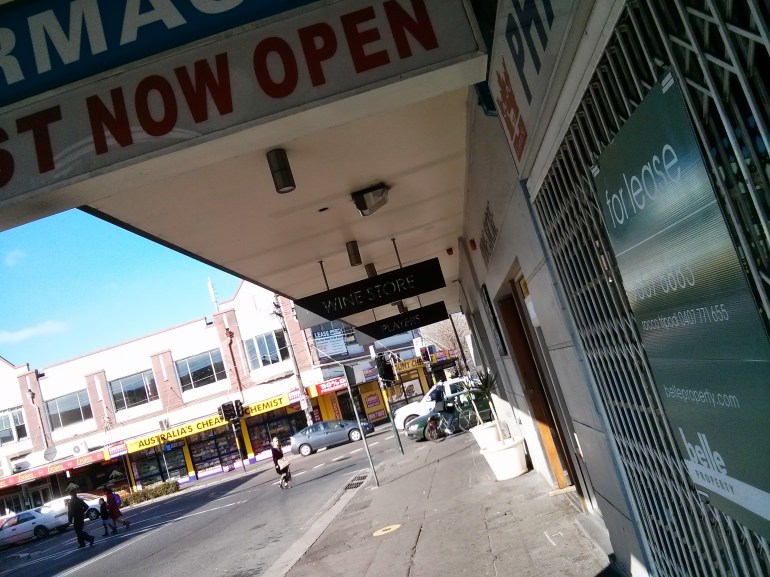
Back in June, I wrote a blog post about the opening of the new discount chemist in Surry Hills.
As I noted at the time, it’s not as if we’re short of chemist shops in my neighbourhood. Within two or three minutes walk from my home, we already have three. Perhaps prophetically, I commented at the time “I hope they don’t suffer as the much larger discount chemist has moved in.”
Two months later, and I spotted the “For Lease” sign on the chemist closest to the new discount warehouse.
Like this:
LikeLoading…
Related
2 Comments
Seeing Singing in the Rain being performed must have been a little surreal.


Seeing Singing in the Rain being performed must have been a little surreal.
Really memorable Andrew