I don’t really know what to say about the floods in Lismore, except they’ve had a deep impact on me, even though I’m many hundreds of kilometres away, and even though for the most part, I’m reasonably relaxed about floods at home, as I have written previously.
“Yeah the river’s up, but it’s nothing to worry about”, I’ve often said to my family previously. They usually rely on me for forecasts, interpretations from the SES/Weather Bureau etc. And for the most part, I tell them not to worry. But this time around. when it was clear about how bad things could be, I told them to worry. I was especially concerned for my older family members. They might have lived through floods in 1954 and 1974, and it was all okay, but this time around, they’re in their 60s and 70s, and no longer as able to move around as much. I’m actually a bit grumpy with them, and their choices to “stay at home” this time, when I was clear with them about the risk. There’ll be a “family debrief” I’m sure. From afar it was difficult to think of my family facing such difficult times.
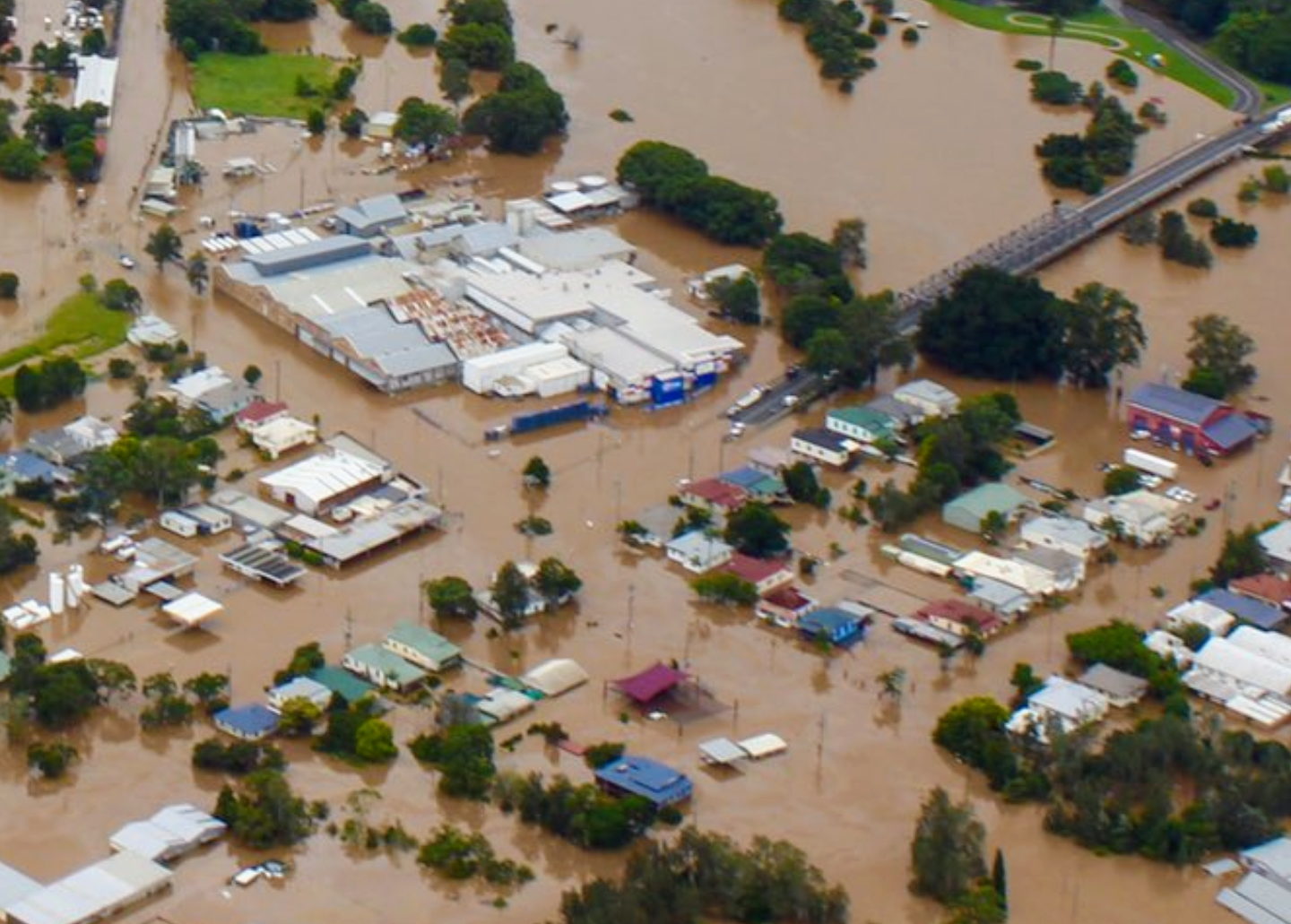
The view from above, thanks to ABC News coverage, where you can see a few family homes surrounded by water.
In explaining my own feelings, I went part of the way this week, on the radio show I present, Editor’s Choice, introducing some interviews from some people from home.
This time a week ago my members of my family were surrounded by about six feet of water. It was, literally, lapping their floor boards. They live in South Lismore, and that’s where I grew up, too.
One of my earliest childhood memories is of the 1974 flood. I remember. It was Sunday night, I was 8 years old, and my dad and I went down the backyard, and knowing a flood was on the way, we went under the house to secure the washing machine in case it floated away, and next door, to secure our car on what we thought was higher ground. We went upstairs, watched the Wonderful World Of Disney, and by the time, the show was over, our house too was surrounded by water.
Before that, my mum and dad told me stories of the 1954 flood, of living in a low-set house, where the water reached the top of the windows, and they lived in the rooftop for four or five days. Mum, dad, my four sisters, my granny, and my uncle. This was the days before the State Emergency Service, when hundreds of people in the area died from drowning.
And now it’s happened again, as Lismore, and many other parts of Australia have either experienced major floods, or have succumbed to Cyclone Debbie. We start this week’s Editor’s Choice, with some of the experiences of the people of just one town, my home town, South Lismore, in these recordings from Samantha Turnbull from ABC Radio in Lismore.
I was on the radio last Thursday night, broadcasting to my home home town. As the team at ABC Radio in Lismore took a break “before the worst of it”, I filled in, remotely from Sydney. Because I know the area very well, and because I know what it’s like to live through a flood, I did the late shift from 11pm to 2am, when they took over again.
There was a moment of realisation for me, as I spoke to the bloke from the SES who told me how serious the problem was.
But in the midst of it all, there was also a moment of joy, as a former school teacher, Barbara Kearney called in to say “hello”.
Thankfully, things aren’t too bad for my family, aside from some buckled walls revealing some asbestos, and losing a little bit of furniture. I think it’s been a wake-up call, though, that they’re no longer the young people they once were, who could climb up into rooftops when the floodwaters come up.
“Are you alright there, mate?”, I was asked by one of the workers (presumably the supervisor) chopping down trees on nearby Cleveland Street earlier today. Along with about a dozen others, I was there simply waiting for a bus. He was obviously mindful of the potentially political and social impact of chopping down trees, these days. As it was a significant local event, I told him I took a couple of photographs, primarily for this blog, and because I like history-making events.
As previously blogged, the Surry Hils Shopping Village is currently undergoing a transformation. The smallish shopping centre is being transformed into something much larger, which will also include residential apartments.
“No worries”, I told him, adding that I was a long-term local.
Trees being chopped down on Cleveland Street.Trees being chopped down on Cleveland Street.
I shared the photographs with friends via email, and on a Facebook group site of interested locals.. The group is primarily concerned about changes to the speed limit on Cleveland Street, to the ability to turn off Cleveland Street, and to the impact on neighbouring streets.
Comments varied from this…
This really gives me the sh*ts- I believe as part of their DA they’re required to replace trees on a 1 for 1 basis, but there’s no way a sapling can replace a 40 year old mature tree- I’m surprised the city didn’t push harder for them to be preserved (on that note, I believe the remaining trees on Baptist street are city owned so they should remain)
…to this.
Sacrificing a few gum trees is a small price for this overdue development.
By the time I got home from work, the trees were all gone.
Later, I reflected on this being the second time in the last few days when I was “in the right place at the right time”.
On Sunday night, I was sitting alone having a beer at Stonewall Hotel on Oxford Street. The rain was tumbling down, and I was staring blankly at the passing parade outside, enjoying my beer.
At about 8.30pm, I thought my eyes were deceiving me when I suddenly saw a naked man walk past. Yes, absolutely, completely naked. He was walking quite briskly, and so at first I thought my eyes were deceiving me, and maybe he was just wearing shorts. Though I could be wrong, he looked 60-something in age, and had one of those all-over tans.
But yeah, he was absolutely naked. I knew for sure when I saw the shocked reaction of someone standing outside having a cigarette. I jumped to my feet and rushed outside to take a photograph to document this other “history-making” event.
A couple of friends and I went to see “Keating – The Musical” last night at Sydney’s Seymour Centre, and I can’t stop raving about it. Funny, thoughtful, and very entertaining.
Mike McLeish was terrific as Keating. From the moment he entered the stage from stage-left, with all of the cool of a member of the Hollywood Rat-pack, to the more physical moments of an energetic performance, he was totally believable as “Keating”. As well as the physical similarity, I also got the impression he understood Keating, meaning he portrayed the bravado, the frailty, the arrogance, all of the many elements that make up Keating’s obviously complex character.
On the other hand, Terry Serio played Hawke and Howard as caricatures: the ever-grinning, ear-tugging Hawke and the buffoon-like war-mongering Howard. There’s a particularly memorable scene as Howard takes on a variety of costumes, including jogger’s outfit, army fatigues, and moleskins. There’s also a moment when Howard and Keating come into the audience to shake hands… and while the audience can’t wait to shake hands with Keating, they recoiled in touching Howard.
But that shouldn’t surprise. This was, after all, an audience which I assume was made up largely of Keating supporters, the so-called “intellectual elite”. I spotted, for example, former ALP numbers man, Stephen Loosely in the audience. But that shouldn’t be a bad thing, as I thought the play had something for everyone.
A shot from interval during Keating – The Musical at Sydney’s Seymour Centre, Australia
And while Keating emerges as a “hero”, there are lots of political jibes from both the left and right. There’s a love song, for example, between Gareth Evans and Cheryl Kernot that had everyone in stitches. Eddie Perfect was hillarious as a Rocky Horror-like Alexander Downer in drag.
There were also some wonderfully tender moments, such as the song Keating sang based on his famous Redfern speech, acknowleding the Aboriginal history of Australia.
It was a hugely entertaining, funny, and well-acted and performed show by a very talented cast, and if you have more than a passing interest in Australian politics you’re bound to enjoy it.
P.S. The SMH has confirmed what we thought: Andrew Peacock was in the audience.
Over a drink or two the other night, I was chatting with a friend and colleague about my brief theatrical career.
All throughout high school, I was always one of the kids chosen to “read aloud” when we studied English.
And of course, with my radio background, there was always a bit of drama here and there.
But it wasn’t until I lived in Renmark that I appeared on stage – properly – for the very first time.
Having met some “theatrical types”, I was encouraged to go along to auditon for the Renmark Theatre Group, a local amateur group.
The first production I was involved in was a pantomime: Jack and the Beanstalk which, I recall, went on for an inordinately long time. As I remember now, I think the production probably went three hours or so.
Renmark Theatre Group – Jack and the beanstalk
And of course, I was selected for the role of Jack’s mother. Very camp. Lots of fun.
The only other production I was involved in was a play called “Bananas” which was a political critique about racism, Nazism and all that kind of thing.
I have some very fond memories of my time with the Renmark Theatre Group, and went looking online last night to see if I could find anything about the group, including hopefully something about my time there.
I do, however, have a photograph from the Murray Pioneer in 1990 (I think)…
I showed the photograph to my friend and colleague today at work. She thought it was a hoot, and so do I.
In the process of developing my podcast, The Limb Shift, I’ve had the privilege of speaking with many individuals about their experiences with limb loss, but my conversation with Kath Tanner is one I find myself returning to constantly.
There is a groundedness in the way she discusses her “previous chapters” and the practicalities of a life interrupted by a freak accident on the M25 in London. Her story isn’t just one of survival; it’s a masterclass in shifting one’s mindset to find a “tribe” and a new way of being in the world.
Kath’s journey began with a moment of academic frugality. While travelling between conferences in Europe with her husband, Steve, they opted for a cheap twenty-seater airport bus instead of the train. A blown tyre on a trailing car sent the bus flipping across the motorway, and in an instant, Kath was “turned around like a bit of a concrete mixer inside”.
She speaks with such vivid clarity about the aftermath—the “amazing man, Dave,” a local who used first-aid training from twenty years prior to apply life-saving tourniquets, and the sound of saws removing seats to reach her. When she eventually woke up in Saint George’s Hospital, with tubes in her mouth, and unable to speak, she tried to use “Morse code with my eyes” to tell Steve she needed the tube out. It’s a moment of levity in a dark memory: “He just thought that I had a twitch in my eye”.
Perhaps the most surreal detail of her recovery was the use of leeches to aid blood circulation in a flap on her hand. Kath jokes that she felt she had “gone on a bit of a time snap back” to old-time London. But while her hands were a visible concern, she didn’t even realise she had lost her foot until the following day.
What strikes me most about Kath is her sheer force of will. Told she would be in a London hospital for at least three months, she gave herself five weeks. She had a son’s ninth birthday to get back for, and she refused to miss it. She is a firm believer that the brain can “help to heal” if you give it the right instructions.
She made it back to Australia three days before the birthday, though her homecoming was complicated by a serious infection that left her feeling like a “leper” in isolation. Yet, the comfort of her community and the unconditional love of her dog—who simply rested his head in her lap—provided the emotional ballast she needed to navigate the long months of rehab that followed.
Kath’s return to “normal” life wasn’t about reclaiming her old self, but about adapting. A former dancer, hockey, and cricket player, she was back on the hockey field in less than a year. She couldn’t sprint anymore, so she played defence and used her presence—and her “game face”—to stop younger players in their tracks. “I just played a different thing a different way and a different mindset,” she told me.
Eventually, the physical toll of playing field sports on a prosthetic led her to golf. It took “twenty-five years and one leg less” to finally join her husband on the course, but she found more than just a sport; she found her “tribe” in amputee golf. For Kath, the game is almost secondary to the shared lived experience. She describes her fellow amputee golfers as a family who would “give you their right leg if you needed it”.
Kath Tanner on the golf course. Pic from Amputee Golf Australia(AGA)
Now living in regional Tasmania, Kath faces the practical hurdles many of us in the amputee community know well—the struggle to find experienced physiotherapists or exercise physiologists in a regional setting. She still travels all the way to Wollongong to see her prosthetist, emphasizing that a “good relationship” and a “pedantic” practitioner are non-negotiable for mobility.
She is currently the only woman playing amputee golf competitively in Australia, a statistic she is working hard to change. She recently hosted a clinic in Melbourne that saw fourteen women attend, offering “hope for more to come out”.
Fifteen years into her journey, Kath’s perspective is one of profound gratitude. She walked away from the “academic ladder” to prioritise her children, her friends, and her new passion for wildlife rescue. She also reminds us to check in on our partners, noting that while she was “moving on,” her husband Steve needed his own therapy through writing to make sense of the trauma.
Her parting words during our chat serve as a perfect mantra for The Limb Shift: “Life is damn good no matter how many bits you’ve got missing. But it’s what you make of it”.
A little bit of sunrise magic and a cheeky shoulder shot from the Dark Mofo nude swim in Hobart;
This is likely the last story I’ll share for a while, as I’m about to head off on an overseas holiday. When I get back I’ll resume work, will share more stories, and start to work solidly towards the podcast launch.
One of the great things about learning Swedish is that when you walk around IKEA, some of the previously strange sounding names for furniture make sense.
Or not.
Today, for example, I noticed items with names such as “lycka” (happiness) and “vänlig” (ordinary/everyday). I bought the ordinary/everyday glasses, by the way, along with a small mirror for my shower, as well as a variety of typical Swedish food. The mirror, by the way was called Vänna which is the name of a town in Sweden.
Vänlig från IKEA
In fact, the food was the main reason for my journey today. I was hankering after some meatballs which I thought were pretty good the last time I visited. Today, however, they were not as good: a little under-cooked, almost resembling rissoles, with the sauce seemingly watered down and “slopped” on the plate. One bright moment, though, was that I asked for, and got extra lingonberries.
In the food stakes, I bought some frozen köttbullar (meat balls), some lingon sylt (lingonberry sauce), some frozen prinsesstårta (a sponge cake with Chernobyl-like green marzipan covering), kopparberg (pear cidar), lingonsaft (lingonberry soft drink) abd two packets of billar (lollies). So the next time I have a meat ball craving, I’m going to attempt it myself instead of making the treck all the way to Rhodes. Roll on IKEA in Tempe, I say.
The evening ahead holds little excitement except for dinner, washing, and a night in front of the television. It was an ordinary day.
Twenty five years ago (or thereabouts) I remember attending the National Choral Championships in Wagga Wagga. Although it sounds fairly tame, the championship organisers found themselves the subject of national media interest, as they asked the Sydney Gay and Lesbian Choir to change their name to the “Eastern Suburbs Choir” (or something like that). The SGLC refused, and went on to win the championships that year in the community choir section.
A year later, they were back in Wagga Wagga. This time around, I was also involved in the National Choral Championships as host for the afternoon session (while the main host took a break). This time around the SGLC didn’t win, sadly. But there was still a lot of joy in seeing them compete. Vividly, I remember the choir invited members of the Riverina Gay and Lesbian Social & Support Group back to a restaurant to join with them in a joyous celebration of song. I also did a report on the event for “The World Today” on ABC Radio, though sadly it’s not in the archives. If you have a copy of the report, I’d love you to get in touch, as it remains a treasured part of my own broadcast history.
Guess what? As I was going through a box of old cassette tapes last night, I made a wonderful discovery: a tape labelled simply, “G&L Choir in Wagga”.
I knew instantly it was a recording from my time as the presenter of the Morning Show on ABC Radio there, and reporting on the success of the Sydney Gay and Lesbian Choir at the National Choral Championships.
Their performance back in 1992 was not without controversy, as the Wagga Wagga “Daily Advertiser” recalled a couple of years ago.
A CONTENTIOUS gay choir that made national headlines after winning a Wagga championship in 1992 will return to the Riverina as a sign of changing times. The Sydney Gay and Lesbian Choir (SGLC) will grace the city for the first time in 24 years after it was embroiled in controversy with organisers calling for the choir to rename in 1992.
It was nice to see “The Daily Advertiser” report positively on the choir, because back in the early 1990s, that newspaper ran a very strong campaign against the local LGBTIQ community, under the leadership of Editor, Michael McCormack, who has gone on to become the Deputy Prime Minister, and who now says, he no longer holds the views he espoused back then.
I digress.
There were two items on the cassette. One was a locally produced story reporting on the championships, which was very much for local consumption. The other was an item when played nationally on ABC Radio’s “The World Today”.
SINGING : There’s a place for us, somewhere a place for us
JO : From West Side Story, Somewhere by the Sydney Gay and Lesbian Choir. The issue was, though, whether Wagga might be that place because, earlier this year, the organisers of the championships had asked the choir to consider changing its name to the “Eastern Suburbs G&L Choir”. The organisers feared a backlash from the local community and from other competitors. Wagga was also the place which, twelve months ago, had called on the state government to stop funding the Gay & Lesbian Mardi Gras (which it doesn’t). But the choir chose not to change its name, to compete on its own terms, and with that, political implications…
Rob Holland, Choir Founder and Publicist: Because every time someone stands up and says ‘I’m gay and lesbian’ it’s a brave act and when seventy people get up and say it and sing it, and win a competition, it’s really wonderful.
JO: Given that earlier adverse publicity about the choir coming to Wagga, was there ever any trepidation about coming to Wagga?
RH: Well, we didn’t quite know what to expect when we got here. In fact, when we got off the train and onto the bus, that was that. But yeah, we had second thoughts and stuff, and so winning in the face of that is even sweeter.
JO: The Gay & Lesbian Choir took first place in the Community Choir section, fighting off six others. With it, political and artistic kudos.
Meredith Knight, Choir Secretary (MK): Were competing tonight in the mainstream, nationally, with other mainstream choirs, and as a gay and lesbian choir, we won. I think that’s really important for the community.
JO: Steven, artistically, what is the significance of this?
Stephen Schafer, Choir Musical Director (SS): Musically, it means the Sydney Gay & Lesbian Choir, which is a group of totally untrained and unauditioned singers, most of whom just can’t read music at all can meet the challenge, can discover something they love sharing and communicating with their friends and the wider community, and perform to an Australian class standard.
JO: After Wagga, what next?
SS: We’ve been invited to sing at the Fifth National AIDS Conference closing dinner, which is a very exciting and prestigious event, and we’re proud to be part of that. We’ll probably mount another concert early next year as part of the Mardi Gras, and we’re planning to release a CD. International touring is not yet crossed off the agenda.
RH: Getting the choir to Wagga was a major undertaking, so New York of London is a bit further off, I think.
MK: And I think we’ll actually aim to go to the Gay Games in New York in two years time. And I would also like to see the choir go to the Australian Gay Games which I understand is in Melbourne, the January long weekend next year. I think we’ll be there.
SS: Well that’s a good thing, because we’re part of an ever-widening, very active community in all areas. It’s just fantastic that gay and lesbian people are everywhere, and are living and functioning, funnily enough, and enjoying it, and starting to say ‘hey, we’re here’…
JO: And celebrating, as we can hear.
SS: Absolutely..
Song: One hand, one heart, there’s a place for us Somewhere.
And this was the item which played locally on ABC Radio in Wagga, which was very much about the success and challenges for the community itself, as the competition gained further national exposure.
JO: Both artistically, and in terms of popularity, the National Choral Championships are undergoing rapid growth and rapid change, and will expand in coming years, according to one of the judges, Adrian Wintle.
Adrian Wintle (AW): We started very modestly, as you’re aware in 1990 with seven choirs actually entering, and it’s been pretty much a slow moving thing, but it’s starting to spread around, the word of these championships, and as people get to hear about it, and realise it is the richest choral event in Australia, we expect to see even more entries next year.
JO: In terms of quality of performance, where to from where, do you expect to attract better choirs from Australia?
AW: We’re all acutely aware, the judicators, that there are squillions of choirs out there in the wilderness, and we would hope that some of the cathedral choirs, for instance, the collegiate choirs, the university choirs, might see fit to come to Wagga. We also held a think-tank session on the Sunday morning after the event, and we as a committee, gleaned from that various things that will help run the championships in the future including, possibly, the subsidisation of choirs coming in, if we’re to gain sufficient sponsorship to cover the basic travel costs, because we are conscious that Wagga being situtated as it is, represents expenditure of a high order for groups coming in from abroad.
JO: But there was also high praise for the choirs which won from the audience…
Voice Over: The first prize for the male and female choir goes to the Melbourne Chorus of Sweet Adelines.
JO: But Adrian Wintle is fast to point out that it’s artistic merit not just popularity that assures a choir of a win.
AW: There’s a yardstick you apply according to the capabilities, the inherent capabilities of a choir. If you’re judging in a community choir section you can’t expect the attainment of that community choir to rival that of a professional or a sub-professional, advanced chamber choir. And the set works reflect that sort of division, if you like. But within the perceived limits of a particular section you look for excellence.
JO: One of the big surprises was the win by the Sydney Gay & Lesbian Choir. Crowded earlier this year in a controversy – they were asked to change their name to the “Eastern Suburbs G&L Choir” – the secretary of the choir feels proud of their achievement, to have won first place in the Community Choir section.
Stephen Schafer, Choir Musical Director (SS): Musically, it means the Sydney Gay &and Lesbian Choir, which is a group of totally untrained and unauditioned singers, most of whom just can’t read music at all can meet the challenge, can discover something they love sharing and communicating with their friends and the wider community, and perform to an Australian class standard.: We also got the positive reception from the Wagga people, who were the organisers of the Choral Championships. They were very pleased that we were here; they were very pleased that we won. And that was from the Wagga people, who organised the championships. And that was just terrific to just be accepted for who we are by the people. The other choirs thought we were terrific. In fact we’ve got some here tonight celebrating with us, and we’ve just got a tremendous response from people, in fact better than we expected.
JO: So where to from now? Adrian Wintle believes the championships will grow, attracting bigger and better choirs…
AW: Overall, I think it speaks of an expansion. We as a committee have to be ready to cope with that. We have to be sensitive to the requirement of these choirs coming in, to offer them the prospect of reasonable accommodation, and for that, we need the assistance of the Motelier’s Association, which support us already. We have to ensure they have adequate rehearsal space when they get here. There was a thing that was floated at the “think-tank” session concerning the use of churches which led to a suggestion, perhaps, we should have a category for church choirs. And all this sort of material from around and aired suggests that we’re on the bring of a choral music explosion.
It was an absolute joy to discover the cassette and to hear the audio all over again. When I went looking in the official ABC archives a couple of years ago, the audio wasn’t there. It hadn’t been digitised. But now it has been, and it’s going into the archives, which is excellent.
PS: If you can help with the names of some of the people I spoke to, I’d really appreciate it.
Like this:
LikeLoading…
Related
4 Comments
The floods are indeed terrible for all those who are affected.
The post office photo shows how shockingly deep the water is.
Yes indeed, S.C. Andrew – these pics give you an onground view of things. https://jamesobrien.id.au/2009/05/22/flood-friday/
I also remember my father (Robert Spinks) talking about the 1954 floods.